

Once you can hold down a few chords, the next thing that transforms your playing is your strumming hand. Strumming gives a song its rhythm, feel, and groove, and a handful of simple patterns will carry you through an enormous number of songs.
The patterns below cover what every beginner should know, from the simplest downstrokes to the famous island strum, with clear counting so you can follow along step by step.
How to Read Strumming Patterns
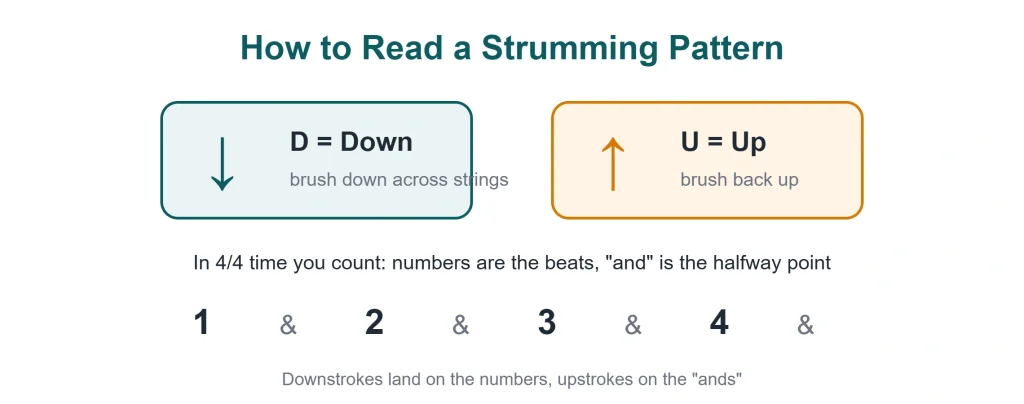
Strumming patterns use a simple shorthand. The letter D means a downward strum, where your hand moves down across the strings, and U means an upward strum, moving back up.
Most beginner songs are in 4/4 time, which means four beats per bar, and we count the beats out loud as “one and two and three and four and.” The numbers are the main beats, and the “ands” are the halfway points between them.
Downstrokes fall on the numbers and upstrokes on the “ands,” which keeps your hand moving in a natural, steady rhythm.
Your Strumming Hand Technique
Before the patterns, a few technique basics will make everything easier. Strum over the spot where the neck meets the body, rather than over the sound hole, for a fuller, more pleasant tone. Use a relaxed motion that comes from your wrist rather than your whole arm, keeping your hand loose and floppy rather than stiff.
Most players strum with the index finger, brushing down across the strings with the fingernail side and up with the fleshy pad, though some use the thumb for a softer sound. Keep the motion gentle; you’re brushing the strings, not hitting them hard.
Pattern 1: All Downstrokes
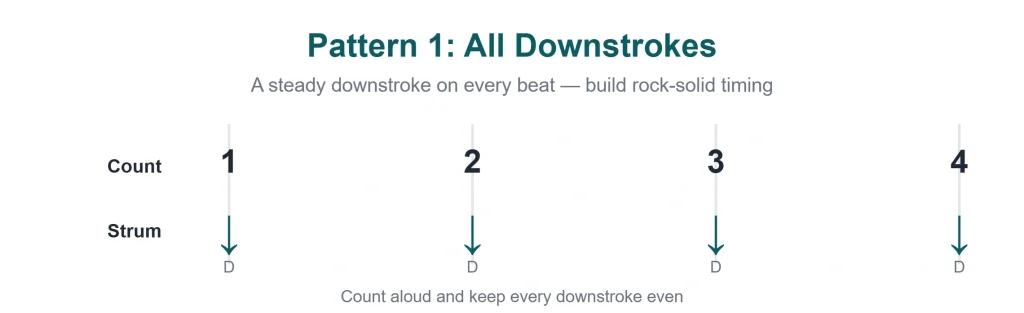
Always start here. Strum a steady downstroke on every beat while counting aloud. It sounds simple, but it builds the most important skill of all: keeping steady time.
Count:  1   2   3   4
Strum:  D   D   D   D
Practice this with a single chord until it feels effortless and even, then try changing chords on each beat. This pattern alone is enough to play many simple songs.
Pattern 2: Down and Up
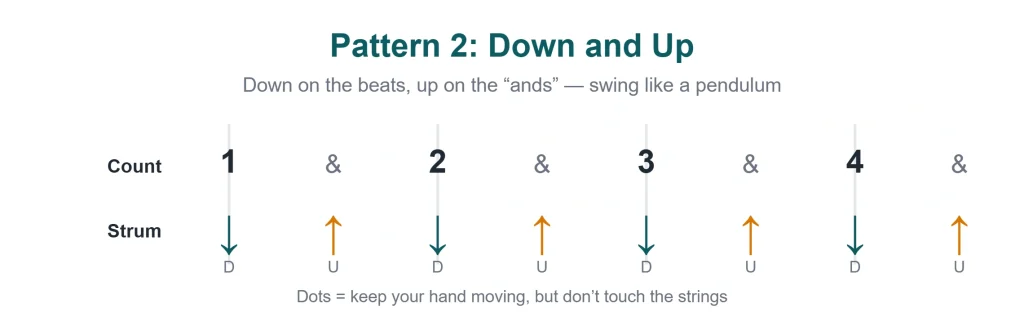
Now add upstrokes. Strum down on each beat and up on each “and.” The key trick is to keep your hand moving down and up without pause, like a pendulum, even when you’re not hitting the strings. This constant motion is the foundation of all more advanced patterns.
Count:  1   &   2   &   3   &   4   &
Strum:  D   U   D   U   D   U   D   U
It will feel busy at first, so start slow. Once your hand keeps time on its own, the next patterns come down to choosing which strums to play and which to skip.
Pattern 3: Down, Down-Up
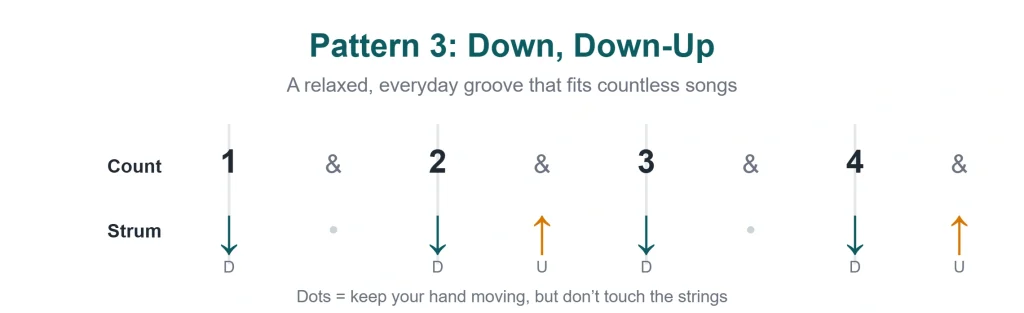
This is one of the most useful everyday patterns, giving a nice, relaxed feel that suits countless songs. Keep your hand moving in that steady down-up motion, but only make contact with the strings on the strums shown.
Count:  1   &   2   &   3   &   4   &
Strum:  D       D   U   D       D   U
The gaps are where your hand keeps moving without touching the strings. Counting out loud while you play makes this pattern click much faster.
Pattern 4: The Island Strum
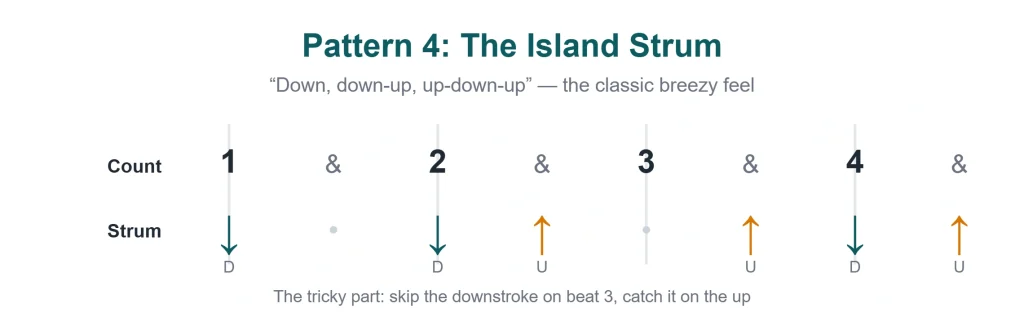
This is the big one. Often called the island strum, this pattern (down, down-up, up-down-up) is the most popular ukulele strum of all, and it gives your playing that breezy, tropical feel. If you learn only one pattern beyond the basics, make it this one.
Count:  1   &   2   &   3   &   4   &
Strum:  D       D   U       U   D   U
The trickiest moment is around beat three, where you skip the downstroke and play only the upstroke just after it. Keep your hand moving down on beat three but miss the strings, then catch them on the way up.
Practice it slow, saying “down, down-up, up-down-up” as you go, and it will lock in. Once it becomes automatic, you’ll reach for it again and again.
Pattern 5: A Simple Waltz (3/4 Time)
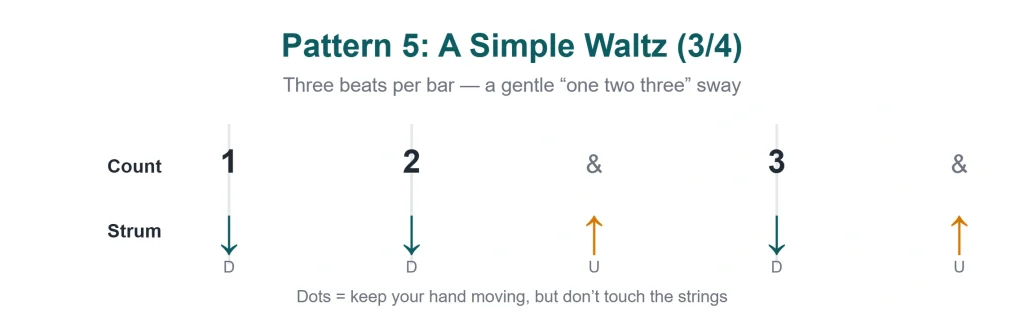
Not every song has four beats per bar. Some, like many waltzes and lullabies, have three, counted “one two three.” A gentle pattern for these gives a lovely swaying feel.
Count:  1   2   &   3   &
Strum:  D   D   U   D   U
Adding a three-beat pattern to your toolkit lets you play a whole different category of songs and deepens your feel for rhythm.
Tips for Better Strumming
A few habits will speed up your progress. Always count out loud, as it keeps your timing honest and helps the patterns sink in. Practice with a metronome or a steady beat, starting slow and only speeding up when a pattern feels relaxed.
Keep your strumming hand moving, even during rests, so your rhythm stays even. A clean, steady, simple pattern sounds better than a fancy pattern played out of time, so prioritize smoothness over complexity.
Timing and hand tension are also two of the most common stumbling blocks for new players, which we cover in our guide to common ukulele beginner mistakes and how to fix them.
Putting It Into Practice
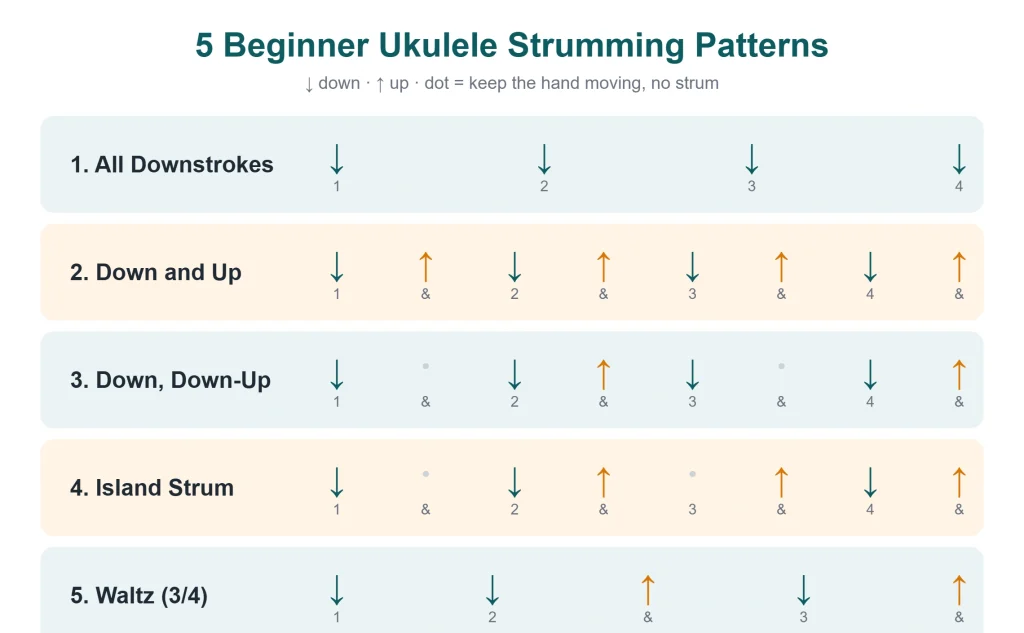
The best way to cement these patterns is to use them on real songs. Pick a simple tune you like, choose a pattern that fits its feel, and play along at a slow tempo. Start with all downstrokes, then try the down-up pattern, and work your way up to the island strum as your confidence grows.
For songs to try these patterns on, see our list of easy ukulele songs for beginners, and for a full foundation revisit our complete beginner’s guide to playing the ukulele.
Keep the Rhythm Going
Strumming is the heartbeat of your playing, and these few patterns will take you a long way. Start with steady downstrokes, add upstrokes, and build toward the island strum, always keeping your hand relaxed and your timing steady. Practice slow, count out loud, and use real songs to make it stick. With a little patience, your strumming will soon feel natural, and that’s when the ukulele starts to sing.
Frequently Asked Questions
What is the easiest ukulele strumming pattern?
A steady downstroke on every beat is the easiest pattern and the best place to start. It builds solid timing, and many simple songs sound great with nothing more than even downstrokes.
What is the island strum?
The island strum is a popular pattern often written as down, down-up, up-down-up. It gives that relaxed, tropical ukulele feel and works with a huge number of songs, which is why teachers reach for it first beyond the basics.
Should I strum with my thumb or finger?
Most players use the index finger, strumming down with the nail side and up with the pad. The thumb gives a softer, mellower sound. Both are correct, so use whichever feels natural and gives you the tone you like.
Why does my strumming sound uneven?
Most often it’s because the strumming hand stops moving between strums. Keep your hand swinging down and up like a pendulum, even on the strums you skip, and count out loud to keep your timing steady.
How long does it take to learn the island strum?
Many beginners get it within a few days to a couple of weeks of regular slow practice. The key is starting slow and saying the pattern aloud until skipping the downstroke on beat three feels automatic.