
Chord progressions explain why so many songs sound satisfying and why a few chords seem to belong together. A progression is the order in which chords are played, and a small number of them power a remarkable share of the music you know.
Once you know a progression, you can play many songs and even start writing your own, which makes it one of the most useful things a beginner can learn. The progressions below use plain language and easy examples in the beginner-friendly key of C.
What Is a Chord Progression?
A chord progression is a sequence of chords played in a particular order, often repeating through a song or a section of it. Progressions create a sense of movement and resolution, a feeling of tension building and then relaxing, which makes music feel like it’s going somewhere.
Certain progressions appear again and again because they sound good to our ears. For beginners, learning one progression can unlock dozens of songs at once.
A Little Theory Made Simple
Musicians often describe progressions using Roman numerals instead of chord names, and it’s worth understanding why, because it’s less complicated than it looks. Within any key, the chords take numbers one through seven based on the scale.
Uppercase numerals mean major chords and lowercase mean minor chords. In the key of C major, the chords line up like this:
Numeral:  I    ii   iii  IV   V    vi   vii°
Chord:    C    Dm   Em   F    G    Am   Bdim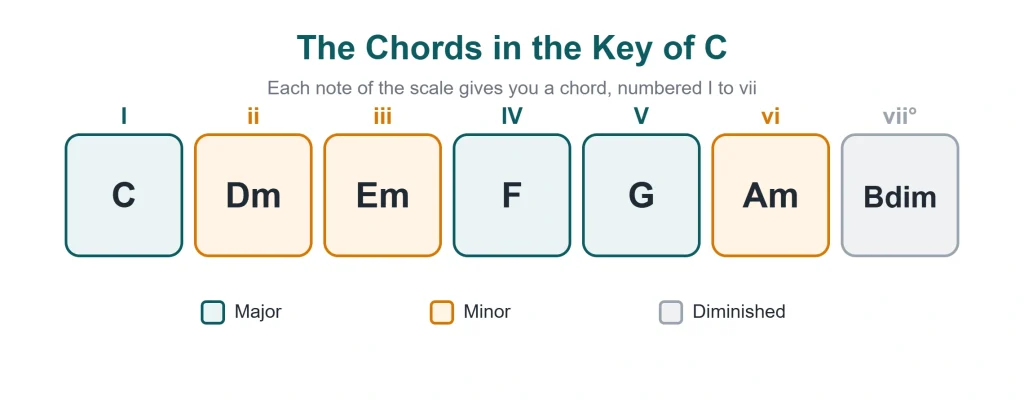
The advantage of numerals is that they describe a pattern that works in any key. A “I–IV–V” progression is C–F–G in the key of C, but the same numeral pattern gives you a different set of chords in another key. For now, we’ll stick to the key of C, because its chords are among the easiest to play on the ukulele and it’s the perfect place for beginners to start.
The Three-Chord Progression: I–IV–V
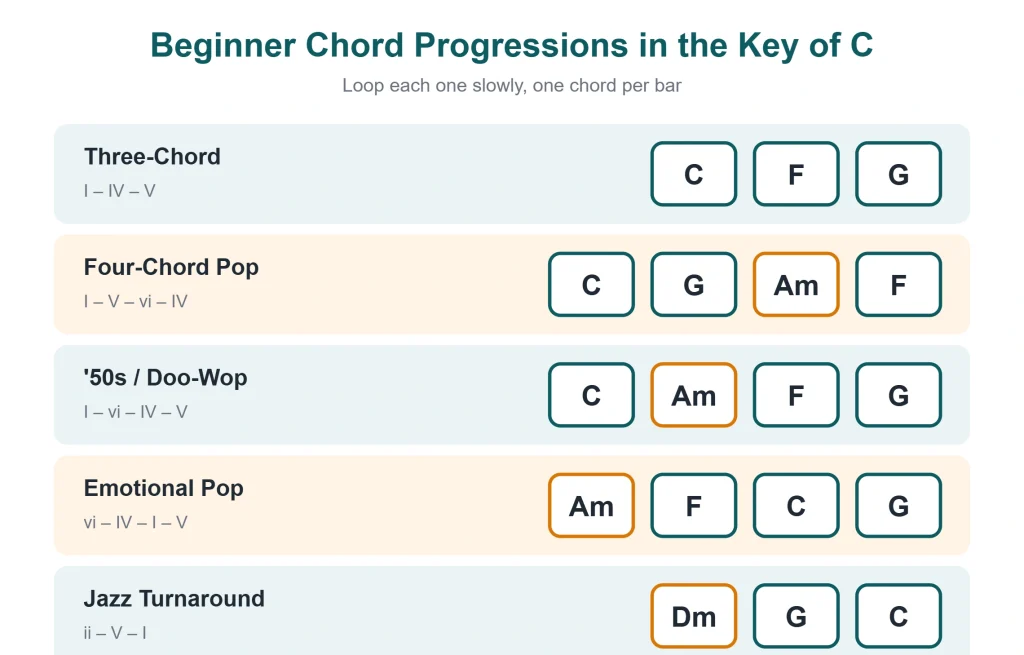
This is the granddaddy of them all, the foundation of blues, folk, country, and early rock and roll. In the key of C, it’s C, F, and G.
I – IV – V
C – F – G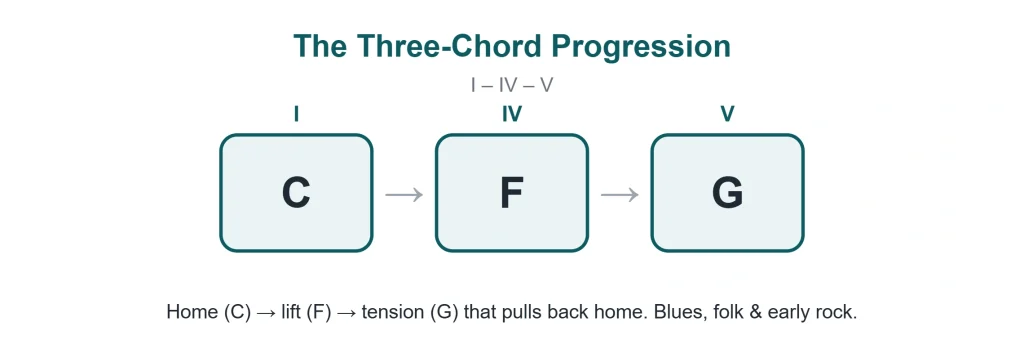
These three chords have a strong, timeless relationship. The I chord (C) feels like home, the IV chord (F) lifts away from it, and the V chord (G) creates tension that wants to resolve back to home.
Play them in a loop and you’ll recognize the sound of countless classic songs. Master this progression first, and much of what follows will make intuitive sense.
The Four-Chord Pop Progression: I–V–vi–IV
If there’s one progression that rules modern pop music, this is it. In the key of C, it’s C, G, Am, and F.
I – V – vi – IV
C – G – Am – F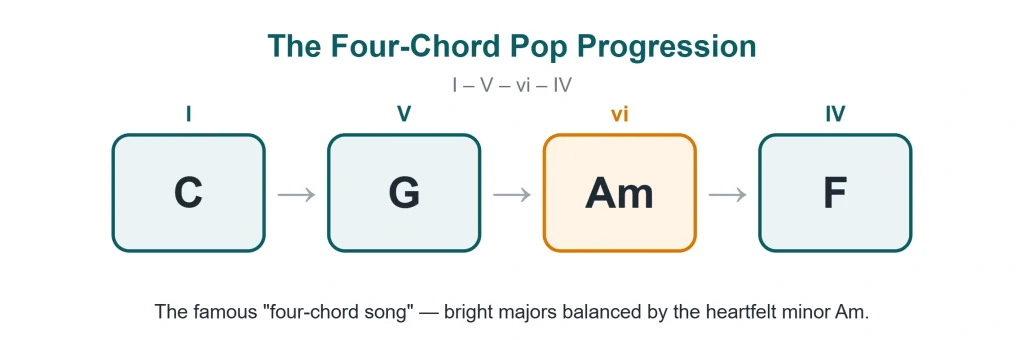
An enormous number of hit songs across every recent decade use these four chords in this order, which is why it’s affectionately known as “the four-chord song.”
It works because it balances bright major chords with the gentle, emotional pull of the minor vi chord (Am), creating something that feels both uplifting and heartfelt. Because these four chords appear so often, learning to switch between C, G, Am, and F is one of the highest-value skills for a beginner.
The 50s Progression: I–vi–IV–V
This one has a warm, nostalgic sound tied to the doo-wop ballads and slow dances of the 1950s and early 1960s. In the key of C, it’s C, Am, F, and G.
I – vi – IV – V
C – Am – F – G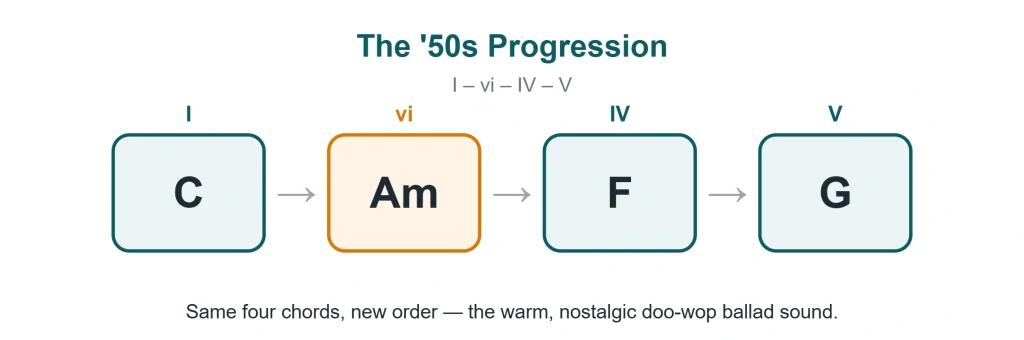
Notice that it uses the same four chords as the pop progression, just in a different order. That small change alters the mood, showing how much the sequence matters, not just the chords themselves. This progression is wonderful for gentle, romantic, or vintage-sounding songs.
The vi–IV–I–V Variation
This variation rearranges those same popular chords, starting on the minor chord. In the key of C, it’s Am, F, C, and G.
vi – IV – I – V
Am – F – C – G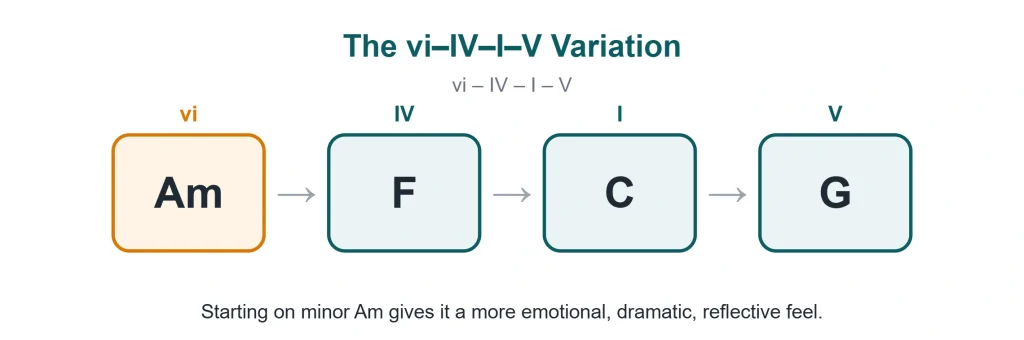
Starting on the minor Am chord gives this progression a more emotional, dramatic, or reflective feel, even though it’s built from the same building blocks. It’s another common pop and rock pattern, and once you can play the four-chord progression, this one takes almost no extra effort.
A Taste of Jazz: ii–V–I
As you grow, you’ll meet the ii–V–I, one of the most important progressions in jazz and a favorite for smooth, sophisticated endings. In the key of C, it’s Dm, G, and C.
ii – V – I
Dm – G – C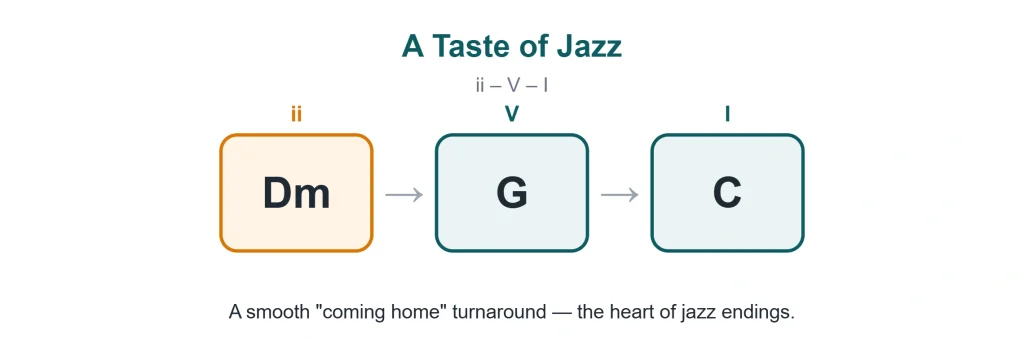
It has a satisfying “coming home” quality, moving through a little tension before landing on the I chord. You don’t need this one on day one, but it’s a lovely progression to know once your basic chords feel solid, and it opens the door to jazzier styles.
How to Practice Progressions
The best way to internalize these patterns is to loop them at a slow, steady tempo. Pick one progression, play each chord for a full four-beat bar, and focus on making the chord changes clean and smooth rather than fast.
Count out loud to keep your timing even, and once a progression feels comfortable, try a simple strumming pattern over the top. Practicing progressions rather than isolated chords trains your hands to make the transitions that songs require, which is why it pays off fast.
To hear these progressions in action, try them on real music using our list of easy ukulele songs for beginners, and pair them with the rhythms in our guide to ukulele strumming patterns every beginner should know. If you still need to learn the chords themselves, start with our easy ukulele chords for beginners.
Unlock the Music
Chord progressions are the hidden framework behind the songs you love, and knowing just a few of them gives you the power to play, follow, and even create music.
Begin with the three-chord and four-chord progressions in the key of C, practice the changes until they flow, and then explore the variations. Once you start hearing these patterns everywhere, you’ll realize you’ve gained one of the most valuable skills a ukulele player can have.
Frequently Asked Questions
What is a chord progression?
A chord progression is a sequence of chords played in a particular order, often repeating through a song. Progressions create movement and resolution, and a few common ones form the basis of a huge amount of popular music.
What is the most common chord progression?
The I–V–vi–IV progression, which is C–G–Am–F in the key of C, is often called “the four-chord song” because so many pop hits use it. The three-chord I–IV–V (C–F–G) is another common foundation.
Why do musicians use Roman numerals for chords?
Roman numerals describe a progression as a pattern that works in any key. Saying “I–IV–V” tells you the relationship between the chords, so you can move the same progression to a different key by using that key’s chords.
Why do the same four chords sound different in different orders?
The order changes which chord feels like “home” and how tension builds and resolves. That’s why C–G–Am–F and C–Am–F–G, built from the same chords, have noticeably different moods.
Which progression should a beginner learn first?
Start with the three-chord I–IV–V (C–F–G), then learn the four-chord pop progression C–G–Am–F. Between them, these two patterns will let you play a large number of songs.