
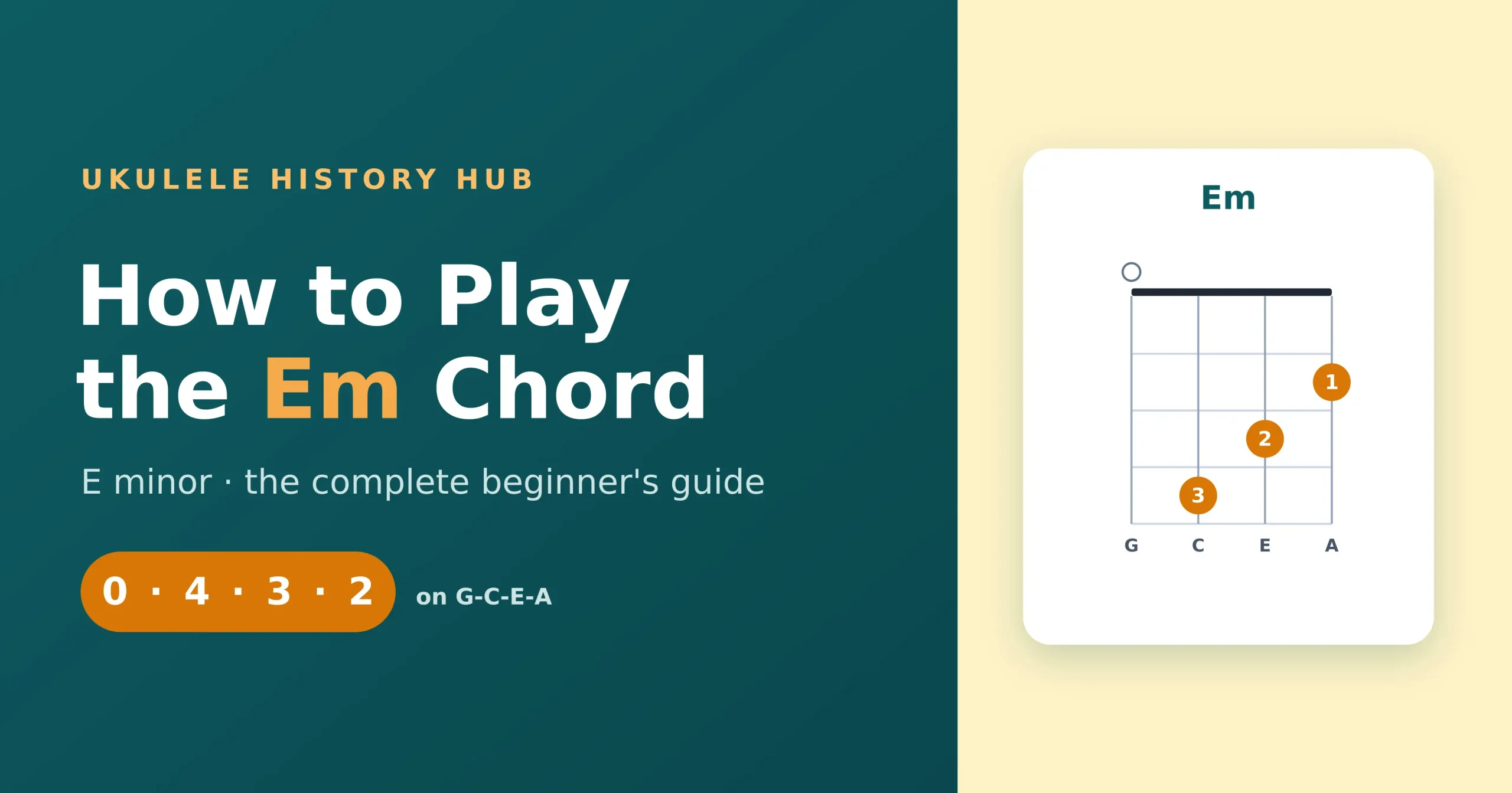
The Em chord (short for E minor) is one of the first minor chords most ukulele players learn. It turns up in a huge number of pop, folk, and worship songs, and it gives your playing that slightly sad, reflective sound that major chords can’t. On a ukulele in standard G‑C‑E‑A tuning, the Em ukulele chord is played 0‑4‑3‑2.
The shape asks for a small finger stretch, but it becomes second nature within a few days. This guide shows you where each finger goes, how to get a clean, buzz‑free sound, and which songs you can play once you’ve got it.
What Is the Em Chord?
E minor is built from three notes: E (the root), G (the minor third), and B (the fifth). That minor third is the note doing all the emotional work. It’s what gives the chord its darker, more thoughtful character compared with the brightness of E major.
On the ukulele you hear those three notes spread across the four strings: the open G string, an E on the C string, a G on the E string, and a B on the A string. Play them together and your ear reads the whole thing as E minor.
Em Ukulele Chord Diagram
Here’s the standard Em shape. In chord diagrams like this one, the thick bar at the top is the nut (the top of the neck), the four vertical lines are your strings from G to A, and the numbered orange dots tell you which finger to use.
At a glance: G string open, C string 4th fret, E string 3rd fret, A string 2nd fret, written as 0 4 3 2.
How to Play Em, Step by Step
Take it one finger at a time. Start with the finger that has to reach the furthest and build the shape around it.
- Place your ring finger on the C string, 4th fret. This is the big stretch, so set it first.
- Put your middle finger on the E string, 3rd fret, just behind the fret.
- Rest your index finger on the A string, 2nd fret.
- Leave the G string open. Don’t let any finger touch it.
- Strum all four strings in one smooth motion and listen for four clear notes.
Keep your fingers curled so you’re pressing with the fingertips rather than the pads, which stops them from flattening onto neighbouring strings. Your three fingers end up in a tidy diagonal line down the fretboard.
If reaching the 4th fret feels like a stretch at first, that’s completely normal; relax your thumb behind the neck and let your wrist drop slightly forward, and the stretch opens up.
Fixing the Buzz: Common Mistakes
Almost every buzzing or muted Em comes down to one of three things. If the chord sounds dead or rattly, run through this list before anything else.
- A finger is lying flat. If the open G string sounds muffled, your middle or ring finger is leaning on it. Curl them more and press on the very tip.
- You’re pressing too far from the fret. Pressing in the middle of the gap causes buzzing. Move your fingers right up behind the metal fret wire.
- Not enough pressure on the 4th fret. The ring finger is the weakest, so it often under‑presses. Give it a firm, deliberate push and check that single string on its own.
A good habit is to pick each string one at a time (G, C, E, A) right after you form the shape. Four clean notes means you’re ready to strum. Make sure your ukulele is in tune first, because even a perfect shape sounds wrong on an out‑of‑tune instrument; our online ukulele tuner takes a few seconds.
Switching To and From Em
A chord is only useful once you can move in and out of it in time. Em pairs constantly with C, G, and Am, so those are the changes worth drilling first.
- Em → C: the easiest change you’ll ever make. Lift all three fingers and drop your ring finger onto the A string, 3rd fret. That’s a full C chord (0 0 0 3).
- Em → G: G is 0 2 3 2. Keep thinking in that same diagonal shape, so your fingers shift rather than starting from scratch.
- Em → Am: Am is just one finger (2 0 0 0). Drop your middle finger onto the G string, 2nd fret, and release the rest.
Practise each pair slowly, back and forth, until the move feels automatic before you add a strum. Speed comes from clean, relaxed changes, not from forcing it.
A Simple Practice Exercise
Here’s a four‑chord loop that puts Em in real musical context. It’s the same progression behind countless pop songs, so it’ll sound familiar straight away:
G → D → Em → C
Give each chord four slow down‑strums, then repeat the loop. Once the changes feel smooth, speed it up gradually. If any shape still buzzes, go back to the one‑string‑at‑a‑time check above. You can explore all four of these shapes side by side in our interactive chord finder.
Songs That Use the Em Chord
Once Em feels comfortable, these well‑known songs are a great way to use it. Each one is built around just a handful of beginner chords, so you can play along without learning anything fancy:
- Stand By Me — Ben E. King (G, Em, C, D)
- Zombie — The Cranberries (Em, C, G, D)
- A Horse with No Name — America (Em and one other shape, a perfect two‑chord warm‑up)
- Hallelujah — Leonard Cohen (C, Em, Am, F, G)
- Mad World — Tears for Fears (Em, G, D, A)
- Boulevard of Broken Dreams — Green Day (Em, G, D, A)
Start with the two‑ and three‑chord songs, then work up to the longer progressions. For more first songs grouped by how many chords they need, see our guide to easy ukulele chords for beginners.
Hear the Em chord for yourself
Open our free interactive chord finder, choose root note E and chord type Minor, and press play to hear exactly how a clean Em should sound. You can see the diagram and the fret numbers side by side.
Open the Chord Finder →Frequently Asked Questions
Is the Em chord hard on ukulele?
Em is a little trickier than one‑finger chords like C or Am because of the stretch up to the 4th fret, but it’s not a barre chord and most beginners have it sounding clean within a few days of short daily practice. The key is setting the ring finger first and keeping the others curled.
Why do my strings buzz when I play Em?
Buzzing almost always means a finger is pressing too far from the fret, not pressing hard enough, or accidentally leaning on the open G string. Check each string one at a time and adjust the finger that sounds dull or rattly.
Is there an easier way to play Em?
The 0‑4‑3‑2 shape shown here is the standard, best‑sounding version. Some players find it comfier using the middle, ring, and little fingers instead of index, middle, and ring. Try both and keep whichever feels natural. There are also higher positions up the neck, but this open shape is the one you’ll use most.
What’s the difference between Em and E7?
Em (E minor) is a three‑note chord with a sad, settled sound. E7 adds a fourth note that creates tension and a bluesy “wanting to resolve” feel. They’re different chords used in different places, so don’t substitute one for the other.
Keep the Em shape in your daily warm‑up alongside C, G, and Am, and before long you’ll be reaching for it without even thinking. From there, every new minor chord gets easier.