

The ukulele lets you start making real music fast. With just a handful of simple chords, you can play along with hundreds of songs. This guide covers the ten easiest and most useful chords for beginners, with exact finger positions for each one, arranged from the simplest single-finger shapes up to a few that use three fingers.
Before you start, make sure your instrument is in tune, since even perfect finger placement sounds wrong on an out-of-tune ukulele. Our guide on how to tune a ukulele walks you through the standard G-C-E-A tuning if you need it.

How to Read These Chord Positions
For each chord, the number tells you which fret to press on each string, reading G, C, E, A from the top string (closest to your face) to the bottom string. A 0 means play that string open, without pressing anything.
For fingers, 1 is the index, 2 is the middle, 3 is the ring, and 4 is the pinky. If chord diagrams are new to you, our beginner’s guide to playing the ukulele explains how to read them in more detail.
All ten chords sit in the table below. Come back to it as a quick reference whenever you need it.
| Chord | G | C | E | A | Fingers used |
|---|---|---|---|---|---|
| C major | 0 | 0 | 0 | 3 | 1 |
| A minor | 2 | 0 | 0 | 0 | 1 |
| C7 | 0 | 0 | 0 | 1 | 1 |
| F major | 2 | 0 | 1 | 0 | 2 |
| A major | 2 | 1 | 0 | 0 | 2 |
| D minor | 2 | 2 | 1 | 0 | 3 |
| G major | 0 | 2 | 3 | 2 | 3 |
| G7 | 0 | 2 | 1 | 2 | 3 |
| D major | 2 | 2 | 2 | 0 | 3 |
| E minor | 0 | 4 | 3 | 2 | 3 |
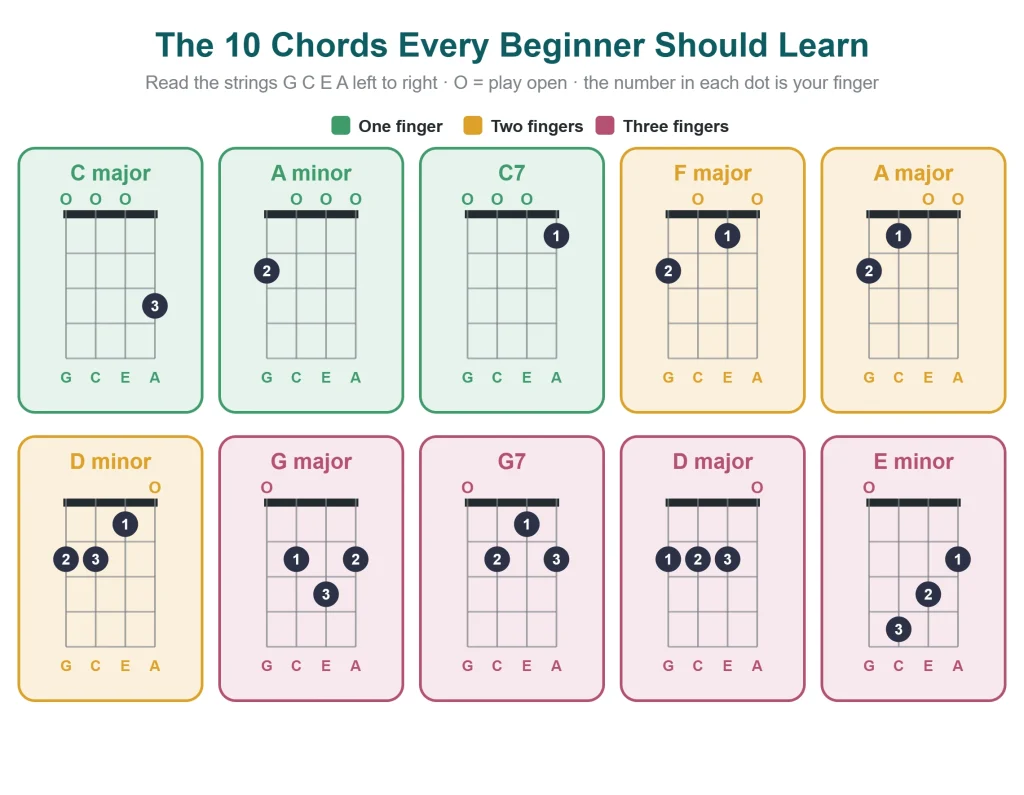
The Three One-Finger Chords
Start here. These three chords each need only a single finger, and together they are enough to play some songs right away.
1. C Major
Place your ring finger on the A string at the 3rd fret and leave the other three strings open. C major is the friendliest chord on the instrument. It sounds bright and complete, and it makes a perfect first chord.
2. A Minor
Press your middle finger on the top G string at the 2nd fret, leaving the rest open. A minor has a soft, wistful sound and pairs well with C major.
3. C7
Put your index finger on the A string at the 1st fret, with everything else open. C7 has a playful, bluesy character and appears in a huge number of cheerful, old-time songs.
The Two-Finger Chords
4. F Major
Place your index finger on the E string at the 1st fret and your middle finger on the top G string at the 2nd fret. Leave the C and A strings open. F major is one of the most common chords in all of music, so it is well worth getting comfortable with early.
5. A Major
Press your middle finger on the top G string at the 2nd fret and your index finger on the C string at the 1st fret, leaving the E and A strings open. A major has a warm, full sound and shows up in countless folk and pop songs.
6. D Minor
Place your index finger on the E string at the 1st fret, your middle finger on the top G string at the 2nd fret, and your ring finger on the C string at the 2nd fret, leaving the A string open.
This shape uses three fingers, but it stays compact and flows straight out of the F chord, so it belongs with the easier group. D minor has a gentle, melancholy tone.
The Three-Finger Chords
These take a little more coordination, but they open up almost any song you will want to play. Be patient with them; they feel awkward for the first week and then turn into second nature.
7. G Major
Place your index finger on the C string at the 2nd fret, your middle finger on the A string at the 2nd fret, and your ring finger on the E string at the 3rd fret, leaving the top G string open.
The three fingers form a small triangle. G major is the chord almost every beginner struggles with at first, and also the one that unlocks the most songs, so it is worth the effort.
8. G7
Put your index finger on the E string at the 1st fret, your middle finger on the C string at the 2nd fret, and your ring finger on the A string at the 2nd fret, with the top G string open. G7 has a bright, resolving sound that leads back to C, so the two are a classic pair.
9. D Major
Place three fingers across the 2nd fret of the top G, C, and E strings, leaving the A string open. Many players use the index, middle, and ring fingers stacked together, though this can feel cramped on a small soprano. If it is a squeeze, try angling your fingers or rolling one a little. D major is common in upbeat, sunny songs.
10. E Minor
Press your index finger on the A string at the 2nd fret, your middle finger on the E string at the 3rd fret, and your ring finger on the C string at the 4th fret, with the top G string open. E minor is a slight stretch up the neck, but it adds a rich, moody color that many beautiful songs rely on.
Tips for Switching Between Chords
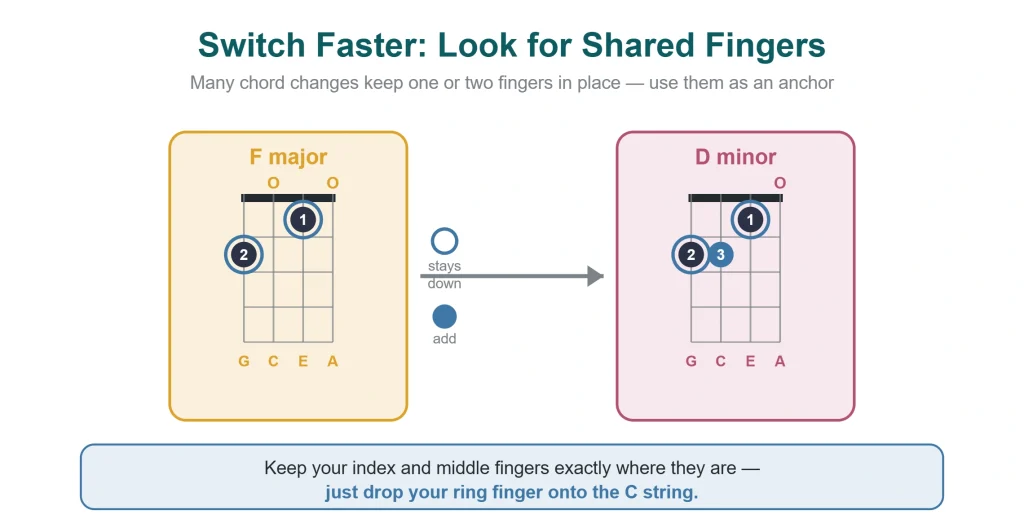
Learning the shapes is only half the job; the real skill is moving between them without a hitch. These habits make a big difference:
- Practice changes in pairs. Pick two chords and switch back and forth at a slow pace until it feels automatic before adding a third.
- Look for common fingers. Some chord changes share a finger or a fret. Keeping that finger in place gives you an anchor and speeds up the switch.
- Keep your rhythm steady. It is better to change chords a little late but keep strumming in time than to stop and fix your fingers. Speed comes with repetition.
- Stay relaxed. Press with your fingertips just behind the fret, keep your fingers arched, and do not squeeze the neck harder than you need to.
Easy Chord Progressions to Practice
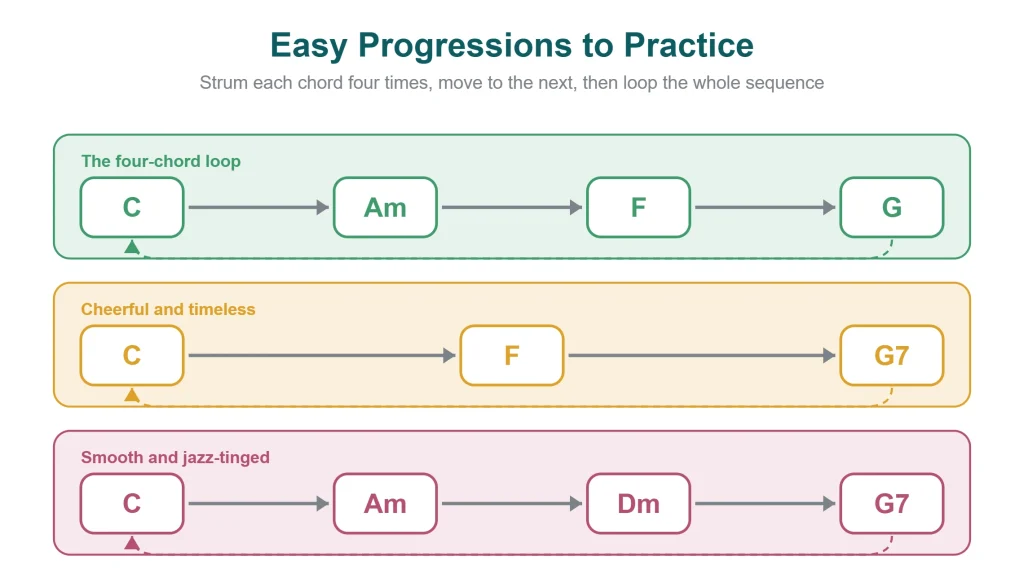
Once you know a few of these chords, try looping these popular progressions. Strum each chord four times, then move to the next and repeat the whole sequence:
- C – A minor – F – G: the famous four-chord loop behind countless pop and classic songs.
- C – F – G7: a cheerful, timeless combination with a satisfying resolution.
- C – A minor – D minor – G7: a smooth, jazz-tinged sequence.
Keep Building Your Skills
These ten chords are the foundation for years of playing. Learn them a few at a time, practice switching between them in short daily sessions, and soon you will be strumming full songs without thinking about where your fingers go.
To put these chords into a complete playing routine, including how to hold the instrument and strum, see our complete beginner’s guide to playing the ukulele.
Frequently Asked Questions
What is the easiest ukulele chord to learn first?
C major is the easiest chord and the best place to start. It needs only one finger, your ring finger on the A string at the 3rd fret, and it sounds bright and complete on its own.
How many chords do I need to play most songs?
Just four chords, C, A minor, F, and G, are enough to play a huge number of popular songs. Learning the ten chords in this guide will let you play the great majority of beginner-friendly music.
Why does the G chord feel so hard?
The G chord uses three fingers arranged in a triangle across different frets, which takes coordination that feels unnatural at first. That is normal. With a few days of short, regular practice, the shape becomes automatic for almost everyone.
How long should I practice chords each day?
Ten to fifteen minutes of focused daily practice is ideal for beginners. Short, regular sessions build muscle memory far better than occasional long ones, and they keep your fingertips from getting too sore.
1 thought on “10 Easy Ukulele Chords Every Beginner Should Learn First”