
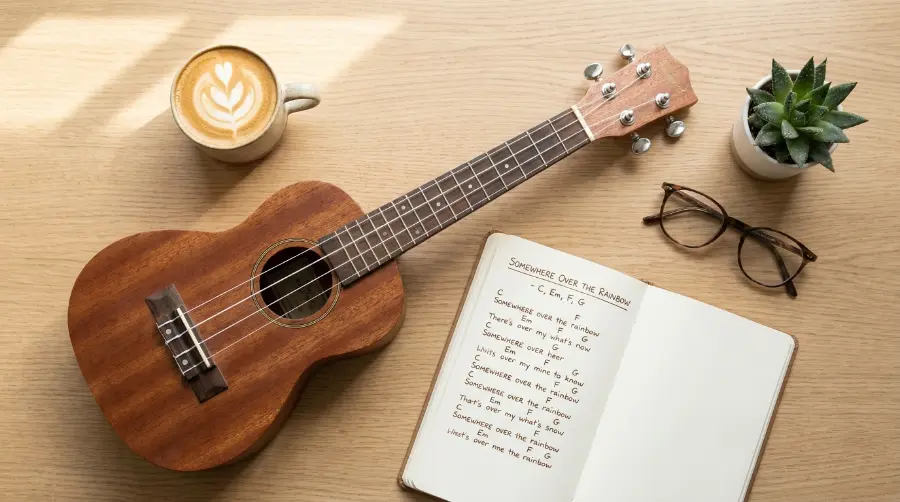
One of the best things about the ukulele is how fast it rewards you. With just a small handful of chords, you can play dozens of real songs within your first week.
The songs below are organized by how many chords you need to learn, starting with the simplest. A few common chord progressions unlock hundreds of popular tunes at once. Grab your ukulele and let’s start making music.
A Few Chords Go a Long Way
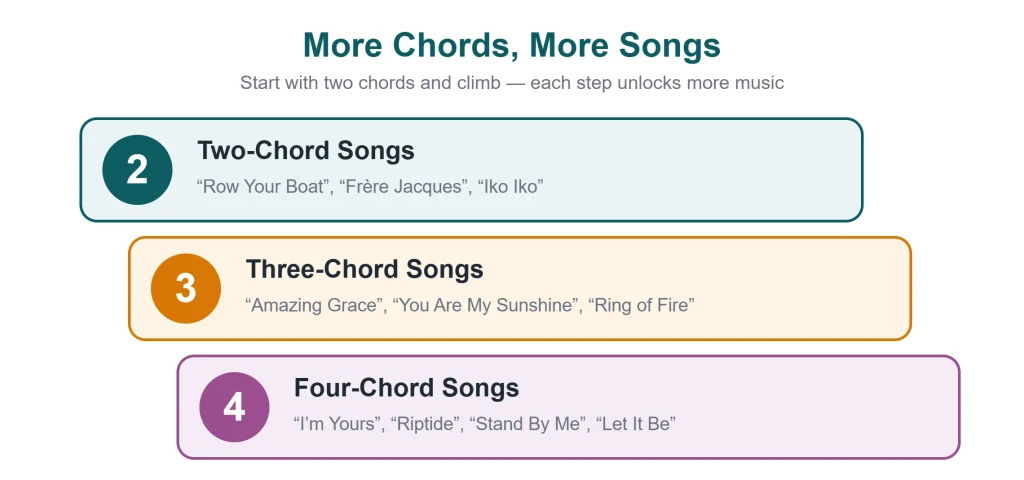
You don’t need to know many chords to play a lot of songs. Most of the songs in this guide use only these four: C, Am, F, and G (or its close cousin G7). If you can switch between those with ease, you can play an astonishing range of music.
If you haven’t learned them yet, start with our guide to easy ukulele chords for beginners, then come back here to put them to use. The C chord takes just one finger, so you can begin playing right away.
The Progressions Behind Hundreds of Songs
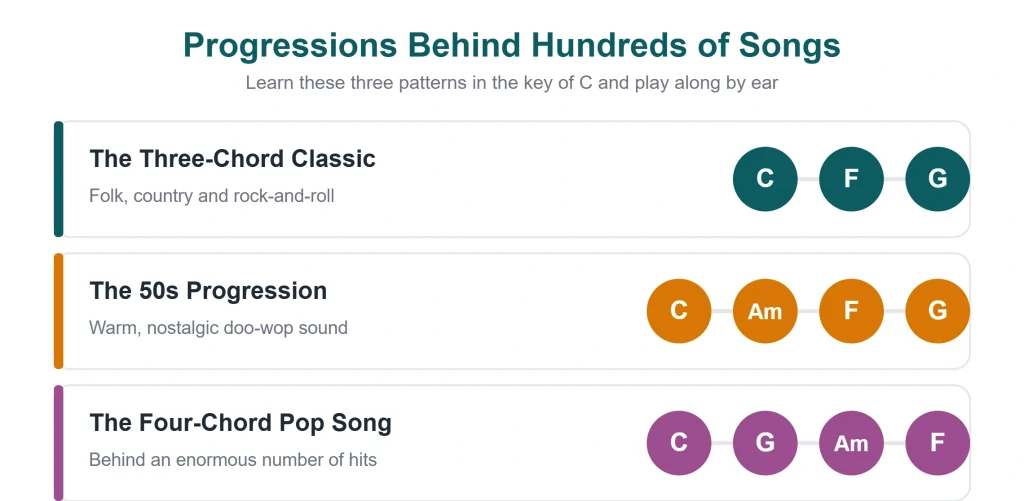
One shortcut will make you feel like you’ve unlocked a cheat code. A huge number of popular songs use the same few chord progressions. Learn these patterns and you’ll recognize them everywhere.
- The three-chord classic (C – F – G): The backbone of countless folk, country, and rock-and-roll songs. Simple, timeless, and useful.
- The 50s progression (C – Am – F – G): That warm, nostalgic doo-wop sound heard in oldies ballads and slow dances.
- The four-chord pop progression (C – G – Am – F): Perhaps the most famous progression in modern pop. An enormous number of hit songs use these four chords in this order, which is why some people call it “the four-chord song.”
Practice looping each progression until the changes feel smooth. Once they do, you’ll be able to strum along with a remarkable number of songs, sometimes just by ear.
Two-Chord Songs to Start With
If you’ve only just learned your first two chords, you can still play real music. Two-chord songs are the gentlest starting point because you only have to master a single change. Traditional and children’s songs are perfect here.
- “Row, Row, Row Your Boat” (traditional) — needs only C and G7.
- “Frère Jacques” (traditional) — works with just C and G7.
- “Iko Iko” — uses just two chords, a fun, rhythmic early song.
Focus on keeping a steady strum and making the single chord change clean. Speed comes later; smoothness comes first.
Three-Chord Songs
Once you can move between three chords, a whole world of folk, country, and classic songs opens up. Many of these use the C, F, and G family.
- “Amazing Grace” (public domain) — a beautiful, forgiving song for practicing slow, clean changes.
- “Oh! Susanna” (public domain, Stephen Foster) — a cheerful, bouncy tune that suits the ukulele.
- “You Are My Sunshine” — a beloved singalong played with C, F, and G7.
- “Ring of Fire” by Johnny Cash — an upbeat three-chord favorite, satisfying to strum.
Public-domain songs like “Amazing Grace” and “Oh! Susanna” are good for practice because you can find the melody and chords for free and focus on your playing.
Four-Chord Songs (Including the Famous Ukulele Hits)
The ukulele comes alive here, because some of the most famous ukulele songs of all time use just four simple chords. If you’ve learned C, G, Am, and F, you’re ready for these crowd-pleasers.
- “I’m Yours” by Jason Mraz — the ultimate beginner ukulele song, built on the C – G – Am – F progression. If you learn one modern song, make it this one.
- “Riptide” by Vance Joy — another iconic ukulele-driven hit, played with Am, G, C (and F). Its bouncy rhythm is pure fun.
- “Stand By Me” by Ben E. King — a timeless classic that uses the 50s progression (C – Am – F – G).
- “Let It Be” by The Beatles — a gentle, uplifting song played with C, G, Am, and F.
- “No Woman, No Cry” by Bob Marley — a relaxed, warm groove that suits the ukulele’s mellow character.
Notice how many of these share the same four chords. That’s the magic of the pop progression at work. Learn the progression once, and each new song means learning a new strumming feel and rhythm rather than brand-new chords.
How to Learn a New Song
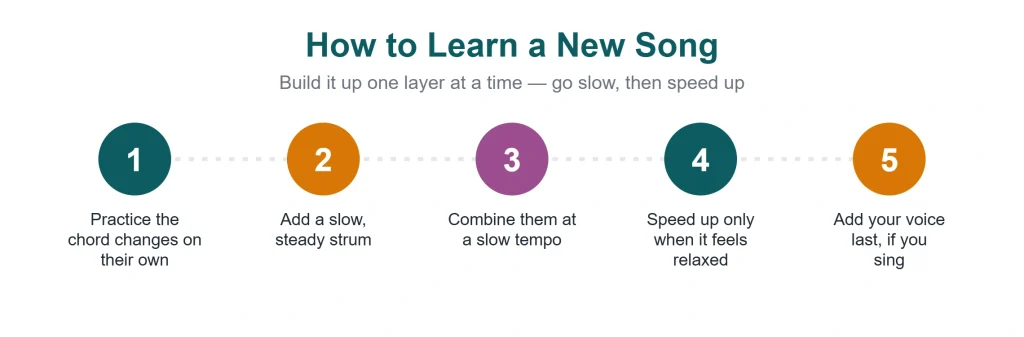
A simple method makes learning any song far easier. Start by practicing just the chord changes on their own, without singing or worrying about rhythm, until your fingers move between them with ease.
Next, add a slow, steady strum, even if it’s just one downstrum per beat. Then bring the two together at a comfortable, slow tempo, and only speed up once it feels relaxed. Add your voice last, if you want to sing along.
Trying to do everything at full speed at once is the most common reason beginners get frustrated, so give yourself permission to go slow.
For a step-by-step foundation in strumming, holding the instrument, and building good habits, see our complete beginner’s guide to playing the ukulele.
Start Strumming Today
The ukulele makes it easy to go from your first chord to your first song in no time. Begin with a two-chord tune, work up to the three- and four-chord classics, and lean on those common progressions to expand your repertoire fast.
Before long you’ll be playing songs you love and having fun doing it. Pick one song from this list, take it slow, and enjoy the moment your practice turns into music.
Frequently Asked Questions
What is the easiest song to play on the ukulele?
Simple two-chord songs like “Row, Row, Row Your Boat” are the easiest, because you only have to master a single chord change. From there, three-chord songs such as “Amazing Grace” are a natural next step.
How many chords do I need to play songs?
You can play real songs with just two chords, and with only four chords (C, G, Am, and F) you can play a huge number of popular tunes, since so many songs share the same progressions.
What’s a good first modern song for ukulele?
“I’m Yours” by Jason Mraz is a classic choice, because it uses the friendly C – G – Am – F progression and has an easygoing rhythm. “Riptide” by Vance Joy is another famous ukulele beginner favorite.
Why do so many songs use the same chords?
Certain progressions, like C – G – Am – F, sound pleasing and satisfying to our ears, so songwriters return to them again and again. That’s great news for beginners, because learning one progression unlocks many songs at once.
Should I sing while I play?
You can, but it’s easier to add singing only after your strumming and chord changes feel automatic. Get comfortable playing first, then bring in your voice.
1 thought on “Easy Ukulele Songs for Beginners (with Chords)”