
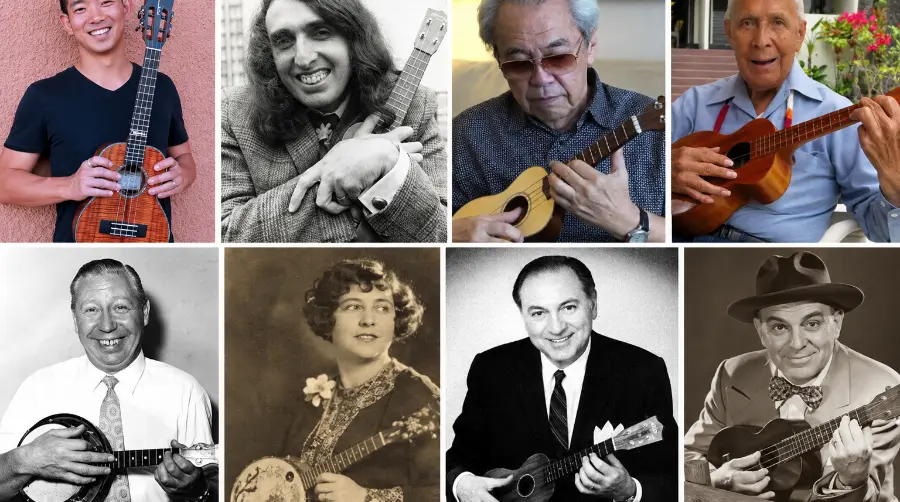
People drove the ukulele’s journey from a small Portuguese import to a beloved global instrument: the makers, entertainers, and virtuosos who fell in love with its sound and showed the world what it could do.
Some sparked crazes, some raised it into a serious solo instrument, and some reminded everyone how joyful four little strings can be. Meet the famous ukulele players and pioneers who shaped the instrument across its history.
The Makers Who Started It All
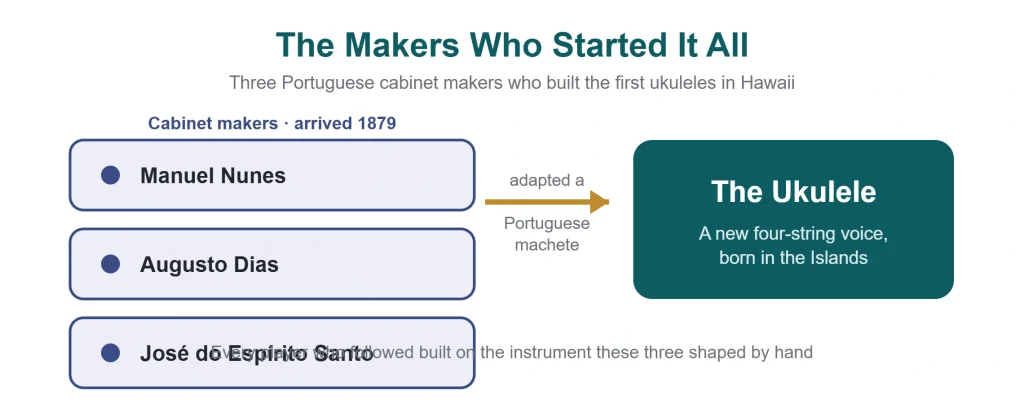
Before there were famous players, there were the craftsmen who created the instrument. When Portuguese immigrants arrived in Hawaii in 1879, three cabinet makers among them, Manuel Nunes, Augusto Dias, and José do Espírito Santo, adapted small Portuguese stringed instruments into what became the ukulele.
Many remember Manuel Nunes as a “father of the ukulele” for his role in building and popularizing the early instruments. Their workshops laid the foundation for everything that followed. You can read more about this origin story in our guide to the history of ukulele brands.
The Jazz Age Stars Who Sparked a Craze
In the 1920s, the ukulele exploded in popularity across the United States, and a handful of performers turned it into a household sensation.
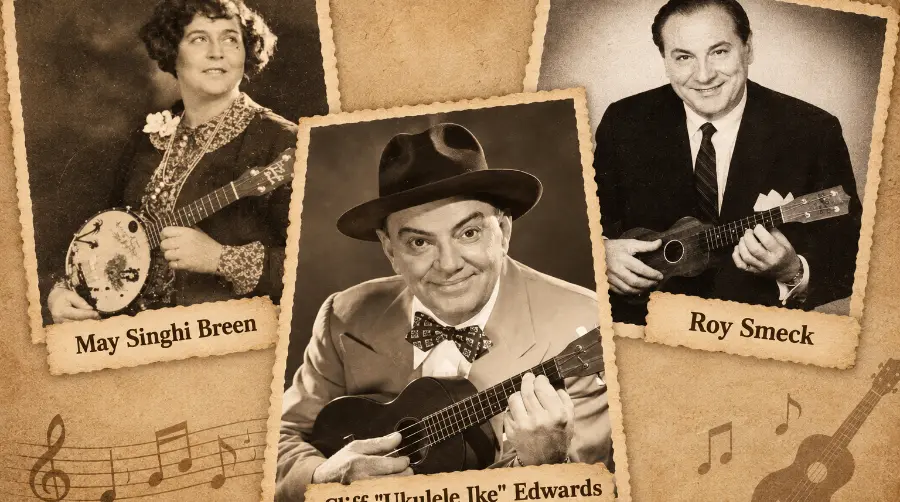
Cliff “Ukulele Ike” Edwards
Cliff Edwards, known as “Ukulele Ike,” was one of the biggest recording stars of the 1920s, selling millions of records and helping make the ukulele the sound of the Jazz Age.
Decades later he reached a whole new audience as the voice of Jiminy Cricket in Disney’s Pinocchio, singing the beloved “When You Wish Upon a Star.” His breezy, cheerful style captured why the ukulele became so popular.
Roy Smeck
Nicknamed “The Wizard of the Strings,” Roy Smeck was a dazzling instrumentalist who performed astonishing feats of technique on the ukulele and other fretted instruments. He appeared in some of the earliest sound film shorts, bringing his showmanship to audiences far beyond the vaudeville stage, and he showed that the humble ukulele could be a vehicle for genuine virtuosity.
May Singhi Breen
Often called “The Ukulele Lady,” May Singhi Breen was a performer and tireless advocate who fought to have the ukulele taken seriously as a real instrument.
She campaigned to include ukulele chord diagrams in printed sheet music and published instructional material, helping countless amateurs learn to play. Her advocacy did much to cement the ukulele’s place in popular music of the era.
The British Icon
George Formby
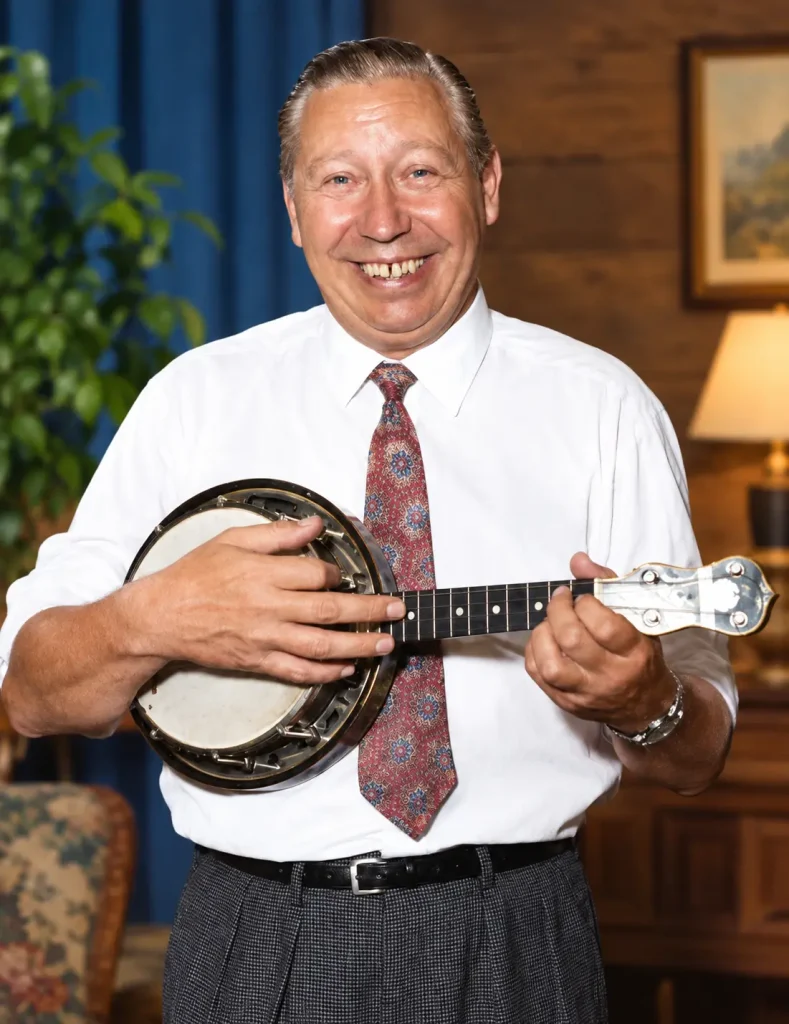
Across the Atlantic, the British entertainer George Formby became one of the most famous ukulele-associated performers in the world during the 1930s and 1940s. He played the banjolele, a banjo-ukulele hybrid, using a rapid strumming technique, and his cheeky comic songs like “When I’m Cleaning Windows” made him a beloved film and music-hall star. Formby’s instrument and playing style are a story in their own right, which we explore in our article on the banjolele.
The Hawaiian Masters
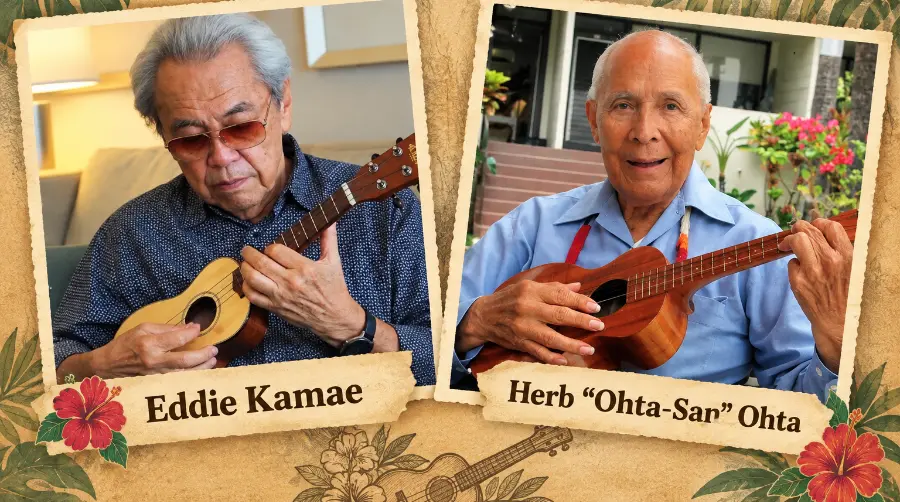
While the ukulele found fame abroad, in its Hawaiian home a generation of masters elevated it from a rhythm instrument into a rich solo and lead voice.
Eddie Kamae
Eddie Kamae was a pioneering Hawaiian virtuoso who helped transform the ukulele into a serious melodic and lead instrument rather than just a strummed accompaniment.
As a co-founder of the influential group the Sons of Hawaii, he played a major role in the revival of traditional Hawaiian music and showed the expressive range the ukulele could reach in skilled hands.
Herb “Ohta-San” Ohta
Herb Ohta, known worldwide as Ohta-San, was a Hawaiian virtuoso who brought the ukulele into jazz, Latin, and international styles, proving it could handle sophisticated melody and harmony. His instrumental recordings, including the much-loved “Song for Anna,” introduced the instrument’s beauty to global audiences and inspired generations of players to take it seriously as a concert instrument.
The Revivalist
Tiny Tim
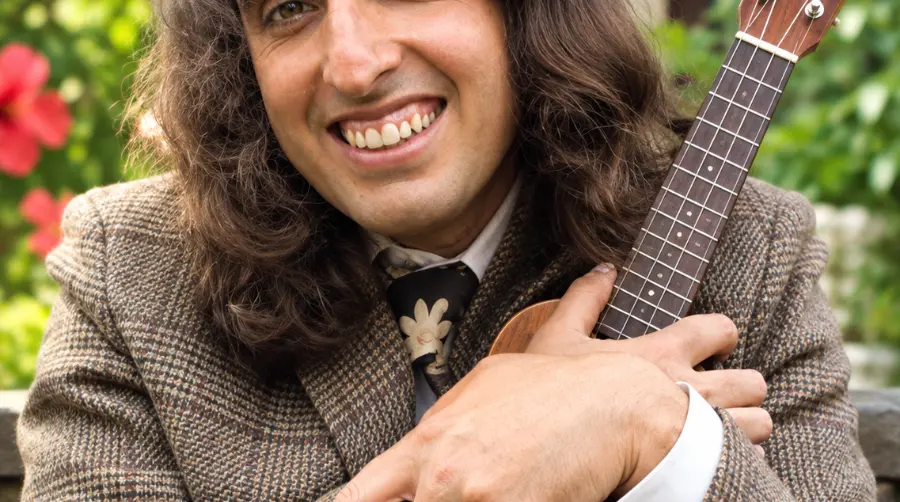
By the late 1960s, the ukulele had faded from the spotlight, until the eccentric performer Tiny Tim brought it back into view. His 1968 hit “Tiptoe Through the Tulips,” delivered in a striking falsetto with his ukulele, became a cultural phenomenon and kept the instrument in the public eye for a new generation, even if his novelty image was a world away from the Hawaiian masters.
The Modern Global Icons
The ukulele’s most recent surge in popularity owes much to two Hawaiian musicians who reached the whole world.
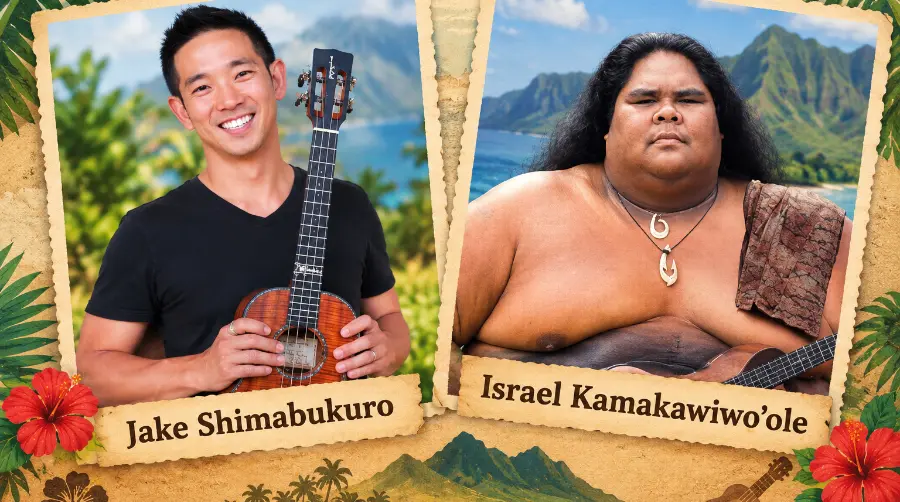
Israel Kamakawiwoʻole
Perhaps no single recording did more for the modern ukulele than Israel Kamakawiwoʻole’s tender 1993 medley of “Somewhere Over the Rainbow” and “What a Wonderful World.” Known to fans as IZ, the Hawaiian musician gave the instrument a gentle, heartfelt voice that has since appeared in countless films, ads, and television shows.
Though he passed away in 1997, his recording remains one of the most cherished ukulele performances ever made. His story deserves its own telling, and we give it one in a dedicated article.
Jake Shimabukuro
If IZ showed the ukulele’s emotional warmth, Jake Shimabukuro showed its jaw-dropping potential. The Hawaiian virtuoso went viral around 2006 with an online video of his intricate arrangement of “While My Guitar Gently Weeps,” stunning millions with a level of speed, dynamics, and expression few knew the instrument could reach. He has since toured the world and inspired a whole new wave of players to see the ukulele as a serious, boundary-pushing instrument.
A Legacy Carried by Its Players
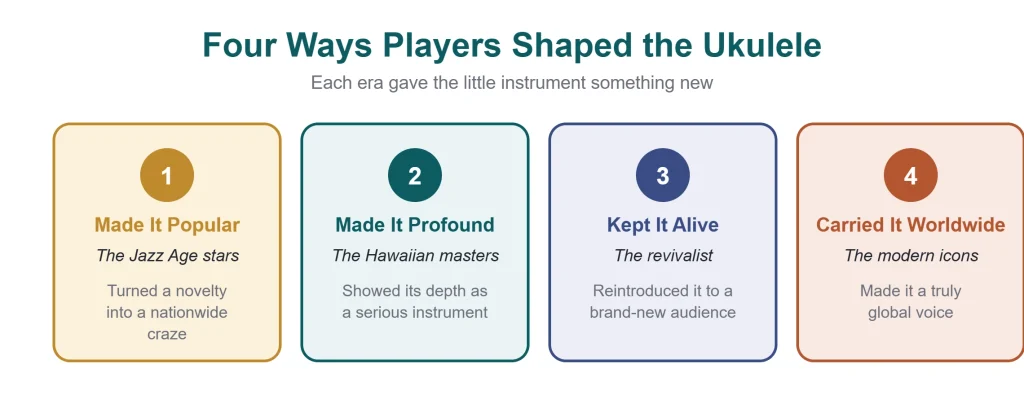
One thing unites these figures across more than a century: each expanded what the ukulele could mean, as a craft, a craze, a serious art form, and a global voice for joy and emotion.
The Jazz Age stars made it popular, the Hawaiian masters made it profound, the revivalists kept it alive, and the modern icons carried it to the world. Every beginner picking up the instrument today is part of the story they built.
Discover More of the Ukulele’s Story
These players each added a chapter to the ukulele’s remarkable history, turning a small island instrument into a worldwide symbol of happiness and music. From Portuguese workshops to viral videos, the instrument’s story is the story of the people who loved it.
To explore where it all began, read our full guide to the history of the ukulele, and if these players have inspired you to pick one up, our complete beginner’s guide to playing the ukulele will get you started.
Frequently Asked Questions
Who is the most famous ukulele player?
Israel Kamakawiwoʻole, known as IZ, may be the most famous, thanks to his beloved 1993 medley of “Somewhere Over the Rainbow” and “What a Wonderful World.” In the modern era, virtuoso Jake Shimabukuro is also celebrated for showing the instrument’s technical potential.
Who invented the ukulele?
Portuguese immigrant craftsmen developed the ukulele in Hawaii after 1879, above all Manuel Nunes, Augusto Dias, and José do Espírito Santo, who adapted small Portuguese stringed instruments. Many call Manuel Nunes a “father of the ukulele” for his role in its creation and popularization.
Who made the ukulele popular?
Several performers popularized the ukulele at different times. In the 1920s, Jazz Age stars like Cliff “Ukulele Ike” Edwards and Roy Smeck sparked a craze in the United States, George Formby made it famous in Britain, Tiny Tim revived it in the late 1960s, and IZ and Jake Shimabukuro drove its modern global popularity.
What did George Formby play?
George Formby played the banjolele, a hybrid instrument combining the body of a banjo with the neck and tuning of a ukulele. Its louder, brighter sound suited his comic music-hall songs, and his rapid strumming technique became famous in Britain during the 1930s and 1940s.
Who is Jake Shimabukuro?
Jake Shimabukuro is a contemporary Hawaiian ukulele virtuoso who rose to fame around 2006 with a viral online video of his arrangement of “While My Guitar Gently Weeps.” He is celebrated for his extraordinary technique and has done much to establish the ukulele as a serious modern instrument.
1 thought on “Famous Ukulele Players Who Shaped the Instrument”