
One of the most recognizable recordings of the last few decades opens with a warm Hawaiian voice, a strummed ukulele, and a tender medley of “Somewhere Over the Rainbow” and “What a Wonderful World.”
Millions of people around the world know the song by heart, even if they never learned the name of the man who sang it. That man was Israel Kamakawiwoʻole, known as IZ, and his simple recording did more to carry the sound of the ukulele to the modern world than almost anything else.
Who Was Israel Kamakawiwoʻole?
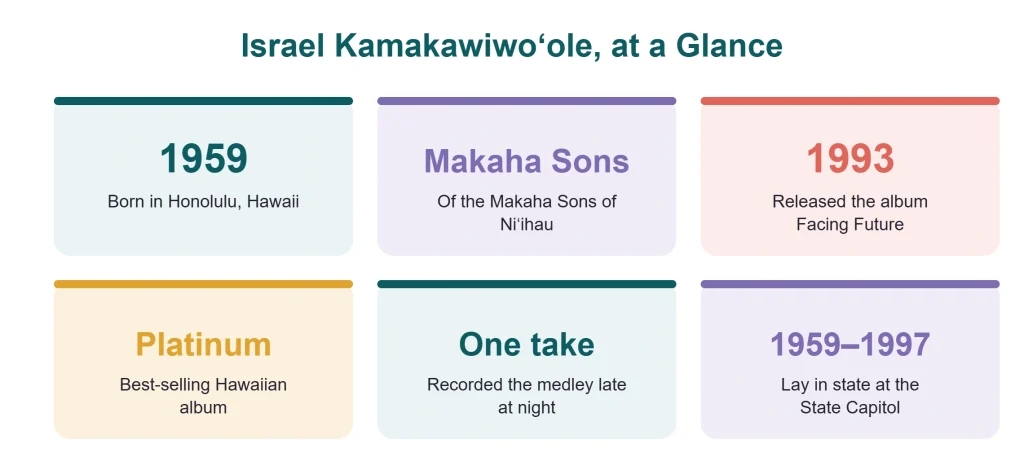
Israel Kamakawiwoʻole was born in Honolulu, Hawaii, in 1959, and grew up immersed in Hawaiian music and culture. Music ran in his family, and he began performing as a young man, developing a gift for gentle, heartfelt singing paired with the ukulele.
He was a large man with an even larger presence, but the softness and sincerity of his voice defined his legacy.
Before his solo fame, he was a member of the Makaha Sons of Niʻihau, a group that played an important part in the revival of traditional Hawaiian music. He later stepped out on his own, and as a solo artist he created the recording that would make him beloved far beyond the islands.
A Voice for Hawaiian Pride
IZ was more than an entertainer. He was a passionate advocate for Native Hawaiian culture and rights, and much of his music carried themes of pride in his homeland and its people.
This deep connection to Hawaii gave his work an emotional weight that listeners felt even when they did not understand every word. His gentle style resonated with so many people for a genuine reason: the warmth was real, rooted in love for a place and its people.
The Story Behind the Recording
The most famous account of how the medley came to be has taken on a life of its own. As the story goes, in the late 1980s IZ called a recording studio in the early hours of the morning and asked to come in and record. An engineer agreed, and IZ arrived in the middle of the night.
There, with just his voice and his ukulele, he recorded the “Over the Rainbow” and “What a Wonderful World” medley, by most accounts in a single take.
That spontaneity is a large part of the recording’s magic. There is nothing polished or overproduced about it, just a man, an instrument, and a melody, captured in one unhurried moment. The recording sat for a few years before it found its home on the album that would make it famous.
What Makes the Version So Special
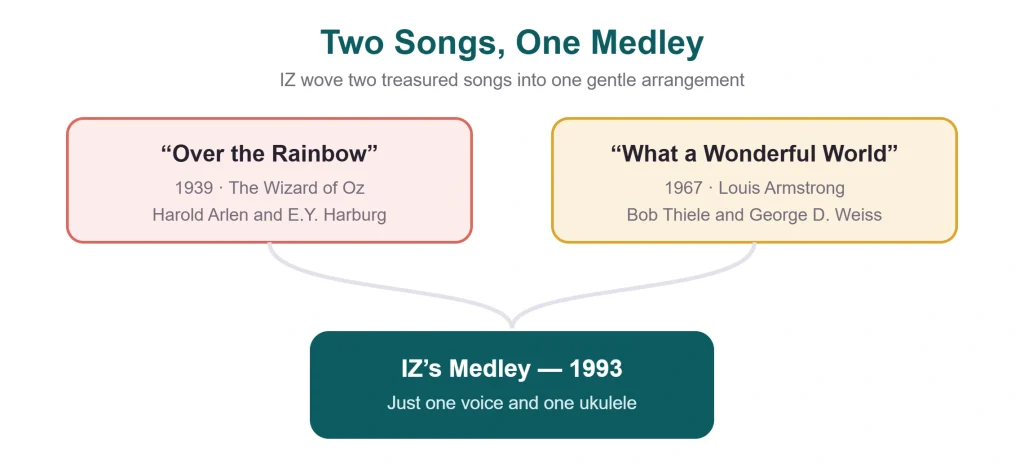
IZ’s arrangement is a medley, weaving together two songs that were already treasured. “Over the Rainbow” came from the 1939 film The Wizard of Oz, written by Harold Arlen and E.Y. Harburg, while “What a Wonderful World,” written by Bob Thiele and George David Weiss, is the song Louis Armstrong made famous in 1967. Both are songs of hope and wonder, and combining them was an inspired choice.
IZ’s version stands apart for its disarming simplicity. Rather than a lush orchestral treatment, he offers only his soft, melancholy voice and the bright, gentle sound of the ukulele.
He also reshaped the familiar melody and chords into something more relaxed and intimate, giving these well-known songs a fresh, Hawaiian feeling. The result is both nostalgic and new, and it shows how much emotional depth a single voice and a ukulele can convey.
“Facing Future” and Growing Fame
The medley appeared on IZ’s 1993 solo album Facing Future, which went on to become the best-selling Hawaiian album, later earning platinum certification. The album captured his warm, rootsy style and introduced his music to a growing audience.
The fame built by degrees at first, but the medley’s gentle appeal proved impossible to resist, and over the years it spread far beyond Hawaii to become a worldwide favorite.
An Early Farewell
IZ struggled with serious weight-related health problems for much of his life, and he died in 1997 at just 38 years old. Hawaii mourned his passing. In a rare honor for a private citizen, his body lay in state at the Hawaii State Capitol, and huge crowds gathered to pay their respects to a man who had come to embody the spirit of the islands. He was gone far too soon, but his music was only beginning its journey around the world.
The Song’s Remarkable Afterlife
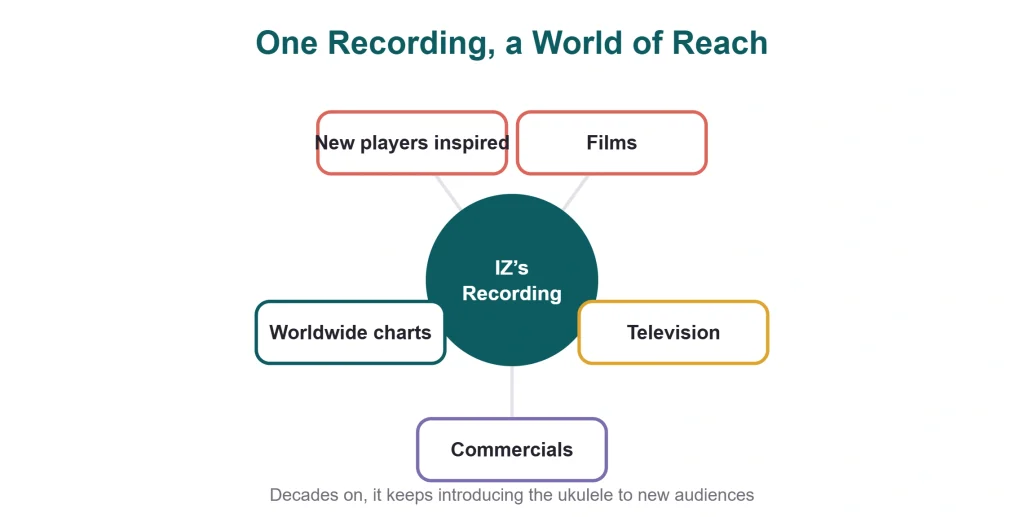
In the years after his death, IZ’s medley became more popular than ever. It has appeared in numerous films, television shows, and commercials, its gentle melody evoking tenderness, hope, and bittersweet emotion.
Each new appearance introduced the song, and the sound of the ukulele, to fresh audiences, and it has charted in countries around the world long after he recorded it.
For many people today, IZ’s recording is what the ukulele sounds like. Its enormous, enduring popularity has kept the instrument in the world’s ear for decades, inspiring countless people to pick one up and try to recreate that warm, comforting sound for themselves.
His Legacy for the Ukulele

Israel Kamakawiwoʻole’s gift to the ukulele was to show its emotional power. Other players had demonstrated the instrument’s cheerfulness or its technical possibilities. IZ revealed its capacity for tenderness and depth.
He proved that four simple strings, in the hands of someone with heart, could move millions. Every beginner who picks up the ukulele because of that famous recording is, in a sense, part of his lasting legacy.
A Song That Keeps the Ukulele Singing
Israel Kamakawiwoʻole gave the world a recording of rare beauty, and in doing so he gave the ukulele a gentle, enduring voice in modern culture. His medley shows that music need not be complicated to move people, and that a single voice and four soft strings can carry more feeling than a whole orchestra.
To meet the other musicians who shaped the instrument, read our guide to famous ukulele players who shaped the instrument, explore the full history of the ukulele, or, if IZ has inspired you, start with our complete beginner’s guide to playing the ukulele.
Note: “Over the Rainbow” and “What a Wonderful World” are copyrighted songs; this article discusses their history and does not reproduce their lyrics.
Frequently Asked Questions
Who sang the famous ukulele version of “Over the Rainbow”?
The Hawaiian musician Israel Kamakawiwoʻole, known as IZ, recorded the famous ukulele version, a medley of “Somewhere Over the Rainbow” and “What a Wonderful World.” It appears on his 1993 album Facing Future and has become one of the most beloved ukulele recordings in the world.
When did Israel Kamakawiwoʻole record the medley?
By most accounts, IZ recorded the medley in a single take during a late-night studio session in the late 1980s. He released it later on his 1993 solo album Facing Future, which became the best-selling Hawaiian album.
How did Israel Kamakawiwoʻole die?
IZ struggled with serious weight-related health problems for much of his life and died in 1997 at the age of 38. Hawaii mourned him, and in a rare honor for a private citizen, his body lay in state at the Hawaii State Capitol.
What two songs are in the medley?
The medley combines “Over the Rainbow,” written by Harold Arlen and E.Y. Harburg for the 1939 film The Wizard of Oz, with “What a Wonderful World,” written by Bob Thiele and George David Weiss, which Louis Armstrong made famous in 1967. IZ blended them into one gentle, hopeful arrangement.
Why is the recording so popular?
Its power lies in its simplicity and sincerity: just IZ’s warm, gentle voice and a ukulele, captured in an unpolished, heartfelt performance. Its use in many films, television shows, and commercials has introduced it to new audiences again and again, keeping it beloved for decades.