
Before you can play a single song on the ukulele, two skills have to click into place: a comfortable hold on the instrument and a steady strumming rhythm. Get these right and everything else becomes easier, because your hands are free to focus on chords instead of fighting to keep the ukulele from slipping.
This guide covers how to hold your ukulele sitting or standing, how to strum cleanly, the strumming patterns you will use most, and how to put it all together into your first song.
How to Hold the Ukulele
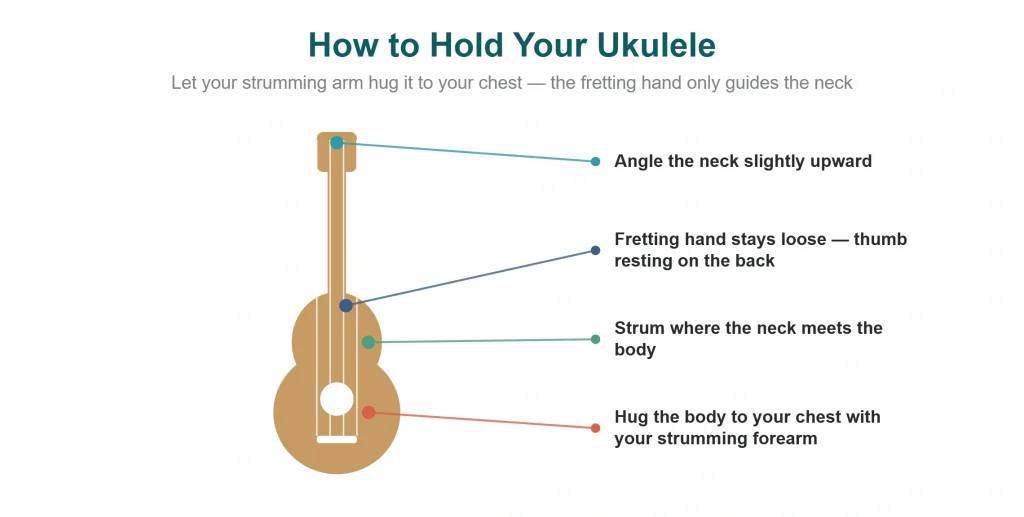
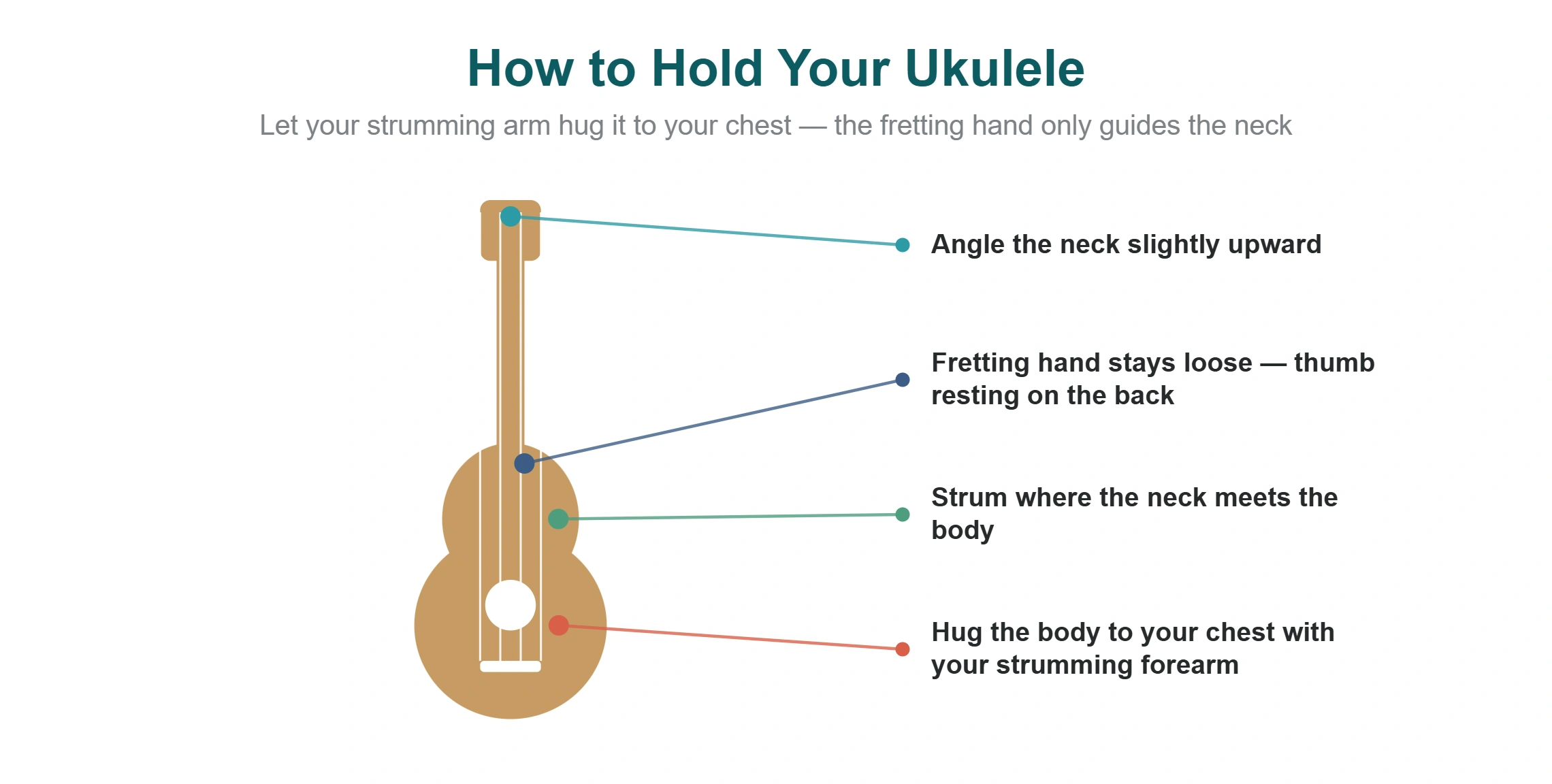
No single “correct” grip works for everyone, but one reliable approach keeps the instrument stable and your hands relaxed. Your strumming arm holds the ukulele against your body, so your fretting hand is free to move without supporting any weight.
Sitting Position
Sit up straight in a chair with both feet flat on the floor. Rest the body of the ukulele against your chest or upper stomach, and hold it in place with the inside of your strumming forearm, roughly where your arm meets your elbow.
The ukulele should feel secure enough that you could let go with your fretting hand and it would not fall. Angle the neck a little upward rather than letting it droop toward the floor.
Standing Position
Standing works the same way: hug the body of the ukulele against your chest with your strumming forearm to hold it in place. Because you have no lap to help support it, many players find a strap useful when standing, especially with larger concert or tenor sizes. Keep the instrument high on your chest rather than low near your waist, which keeps both hands in a natural, comfortable position.
Your Fretting Hand
Your other hand supports and shapes the chords on the neck. Let the neck rest in the gentle valley between your thumb and index finger, with your thumb on the back of the neck, roughly opposite your fingers. Keep your wrist relaxed and a little forward so your fingers can arch over the strings and press with their tips.
Avoid wrapping your hand around the neck or letting your palm clamp against it, because a tight grip slows your finger movement and tires you out fast.
Should You Use a Strap?
A strap is optional but helpful, above all for beginners who find the instrument keeps sliding. Ukulele straps come in several styles, from simple loops that hook around your body to strap-button setups.
One takes the job of holding the ukulele away from your arms, letting both hands relax and focus on playing. If holding the instrument feels like a constant struggle, a strap is worth trying.
Common Holding Mistakes
- Gripping the neck too tightly, which makes chord changes stiff and slow.
- Letting the neck point down toward the floor, which cramps your fretting wrist.
- Holding the ukulele too low, forcing your arms into awkward angles.
- Supporting the whole instrument with your fretting hand instead of your strumming arm, which locks up your fingers.
How to Strum the Ukulele
Strumming turns silent chord shapes into music. Good strumming comes from relaxation and rhythm more than strength.
Where to Strum
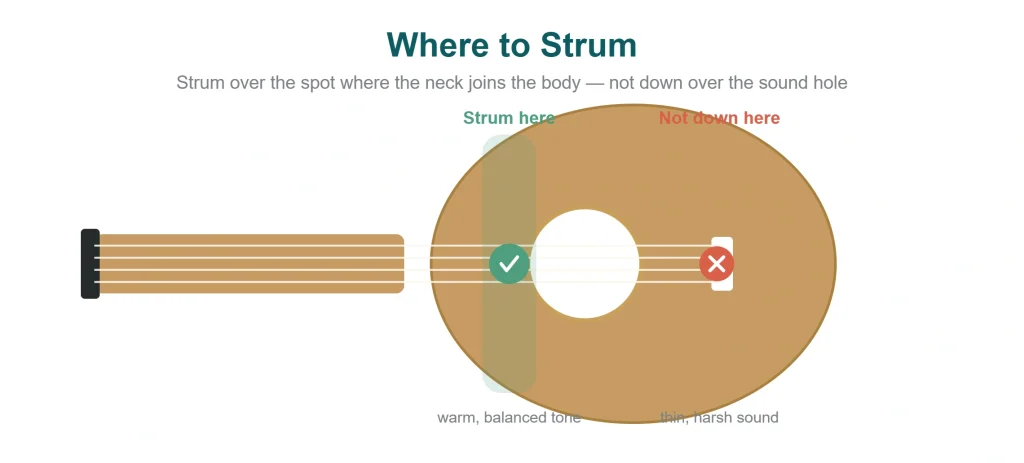
Strum over the spot where the neck meets the body, roughly over the top edge of the soundhole, rather than in the middle of the body as you would on a guitar. Strumming in this area gives the ukulele its warm, balanced tone and keeps your strokes controlled.
Using Your Index Finger
The most common strumming technique for beginners uses the index finger. For a downward strum, brush down across all four strings with the nail side of your index fingertip, moving from the top G string toward the bottom A string.
For an upward strum, brush back up across the strings with the fleshy pad of the same fingertip. Keep the motion light; you are brushing the strings, not hitting them.
Strumming with Your Thumb
Some players prefer strumming with the thumb, especially for softer, gentler songs. You brush down across the strings with the side of your thumb. Thumb strumming produces a mellow, rounded tone and is a nice option to have, though the index-finger method gives you easier up-and-down strokes for faster patterns.
Keep Your Hand Relaxed
The most important strumming tip is to stay loose. Let the motion come from your wrist, as if you were shaking water off your fingertips, rather than from your whole stiff arm. A relaxed wrist gives you an even, pleasant sound and lets you play for longer without tiring. Almost every beginner strums too hard and too stiff at first, so ease off and let your hand flow.
Basic Strumming Patterns
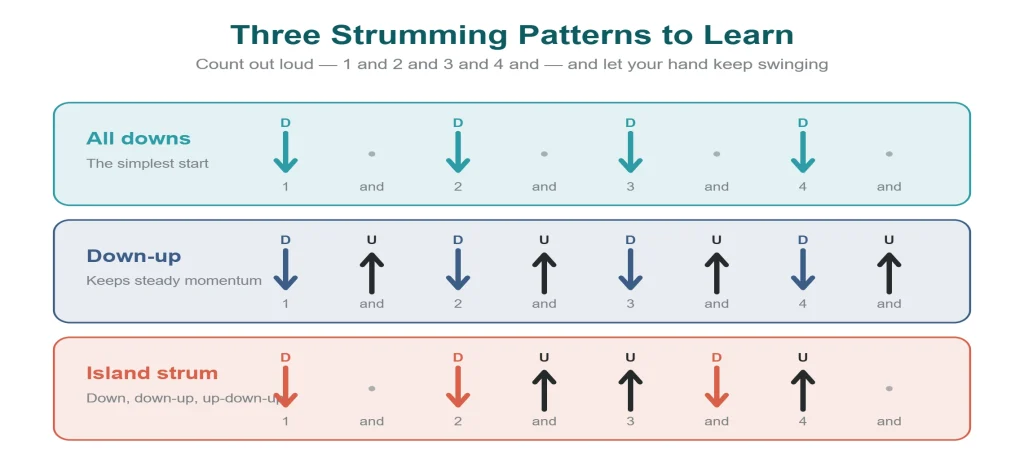
Start with the simplest pattern and add complexity only once it feels automatic. Practice each one on a single chord so your strumming hand can learn the motion on its own.
- All down strums: four steady downward strums per chord, counted “1, 2, 3, 4.” This is the best starting point and sounds musical on its own.
- Down-up strums: alternate down and up strokes, counted “1-and-2-and-3-and-4-and.” This doubles your rhythm and feels lively.
- The island strum: the signature ukulele pattern, going down, down-up, up-down-up. It sounds more advanced than it is, and once your hand memorizes it, the pattern fits an enormous number of songs.
Whichever pattern you use, keep counting out loud or tapping your foot. A steady beat matters more than fancy strumming, and it is what makes you sound good.
Strum Your First Song
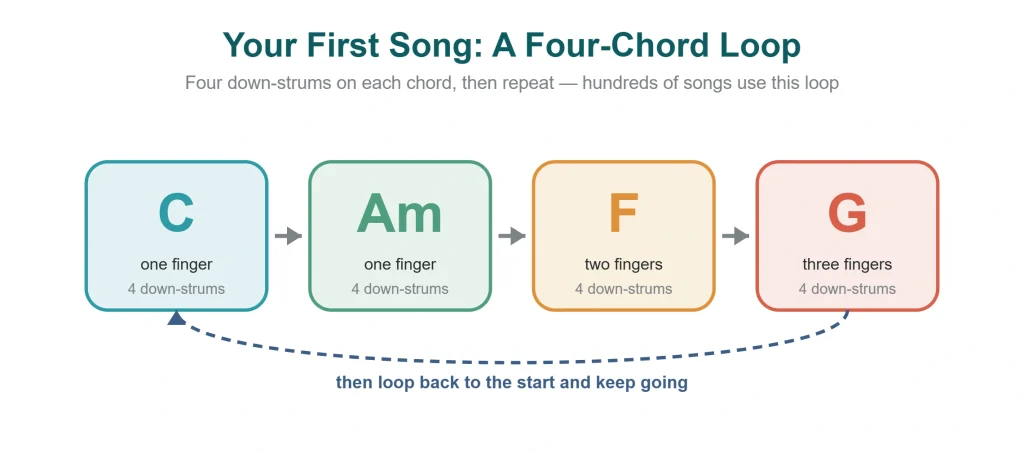
You can play along with a great many songs using just four chords: C, A minor, F, and G, looped in that order. If you need the finger positions for these, our guide to easy ukulele chords for beginners lays them out finger by finger.
Build up to a full song like this:
- Make sure your ukulele is in tune first. A quick check with a tuner keeps everything sounding right.
- Start with four slow down strums on the C chord, then switch to A minor for four strums, then F for four, then G for four, and loop back to C.
- Do not worry about speed. Your goal is a clean chord change while the strum stays steady.
- Once the changes feel comfortable, reduce to two strums per chord, then try a down-up or island pattern.
- Finally, play along with a slowed-down recording of a simple song you love. Matching a real song is one of the fastest and most enjoyable ways to improve.
If your chord change lags behind, keep strumming in rhythm and catch up on the next chord rather than stopping. Keeping time is the habit that makes everything sound like real music.
Common Strumming Mistakes to Avoid
- Strumming too hard. Heavy strumming sounds harsh and tires your hand. Aim for a light, brushing touch.
- Stiff arm motion. Strum from a loose wrist, not a rigid forearm.
- Stopping to fix chords. Keep the rhythm going even if a chord is not perfect; smoothness comes with time.
- Strumming in the wrong spot. Strum where the neck meets the body, not over the middle of the soundhole.
Keep Strumming
A comfortable hold and relaxed, steady strumming are the foundation for everything else. Keep your grip loose, let your strumming wrist flow, and hold a steady beat even when your chords are not yet perfect.
With a little daily practice, holding and strumming will turn into second nature and you will be playing full songs before you know it.
For a complete overview of getting started, including tuning and reading chords, see our complete beginner’s guide to playing the ukulele.
Frequently Asked Questions
What is the correct way to hold a ukulele?
Hold the body of the ukulele against your chest and press it in place with the inside of your strumming forearm, so your fretting hand is free to move on the neck. The neck should angle a little upward, and your fretting hand should cradle it with a loose grip, thumb on the back.
Do I strum with my thumb or fingers?
Both work. Most beginners strum with the index finger, using the nail on the way down and the pad on the way up, because it makes up-and-down strokes easy. Strumming with the thumb gives a softer, mellower tone and is great for gentle songs. Try both and use whichever feels natural for the song.
Where exactly should I strum on the ukulele?
Strum over the area where the neck meets the body, roughly over the top edge of the soundhole. This spot gives the warmest, most balanced tone. Strumming in the middle of the body, as guitarists often do, tends to sound thin on a ukulele.
Do I need a strap to play the ukulele?
No, a strap is optional. Many players hold the ukulele with their forearm alone. That said, a strap can make holding the instrument much easier, especially when standing or playing a larger size, so it is worth trying if the ukulele keeps slipping.
What is the easiest strumming pattern for beginners?
Four steady down strums per chord, counted “1, 2, 3, 4,” is the easiest pattern and sounds musical on its own. Once that feels comfortable, add up strokes for a down-up pattern, and later try the island strum: down, down-up, up-down-up.
1 thought on “How to Hold a Ukulele and Strum Your First Song”