
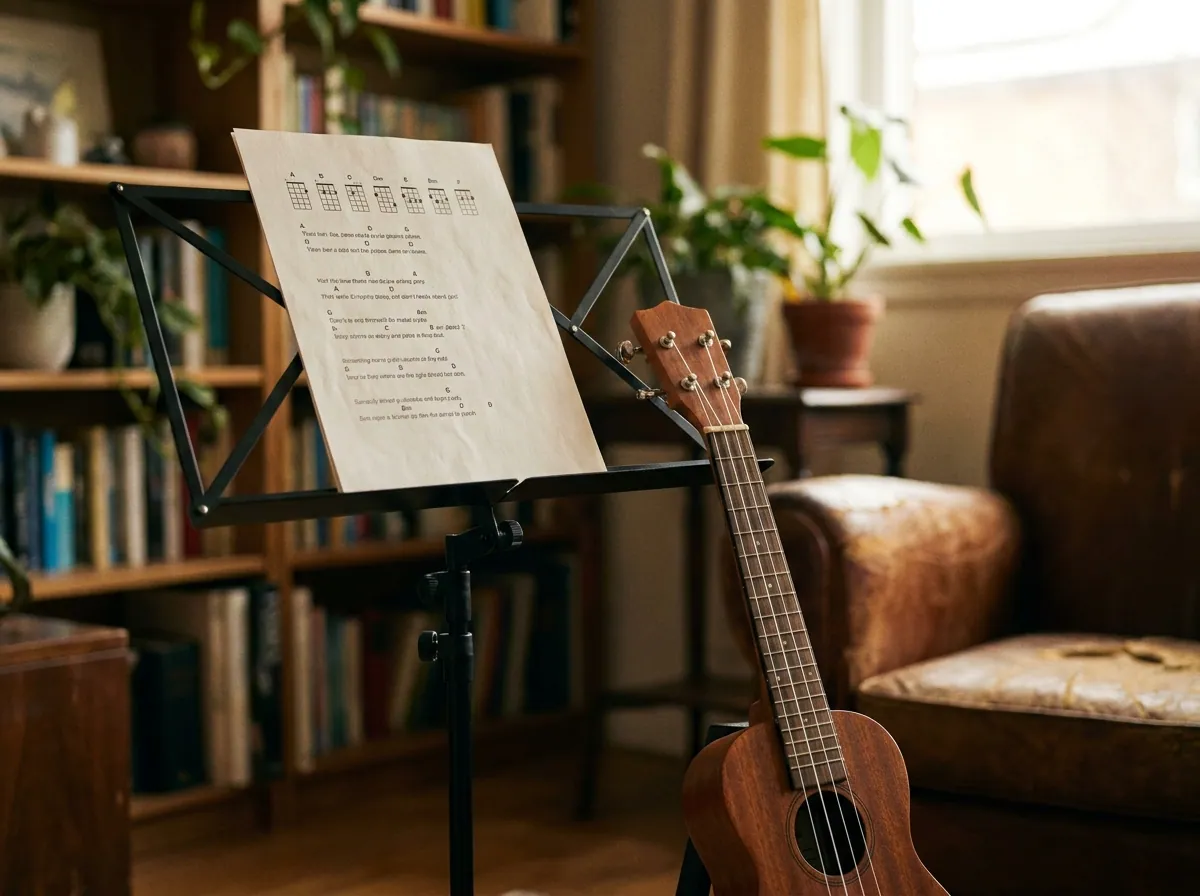
When you start learning the ukulele, you will run into two kinds of written music: chord diagrams and tabs. They look mysterious at first, but both are simple picture-based systems that let you play without reading traditional sheet music.
Once you understand them, you can pick up almost any song sheet online and start playing. This guide breaks down what every line, number, dot, and symbol means.
Chord diagrams show you how to hold a single chord. Tabs show you which individual notes to play and in what order. Most beginners use chord diagrams for strumming songs and tabs for melodies or fingerpicking.
Part 1: How to Read Ukulele Chord Diagrams
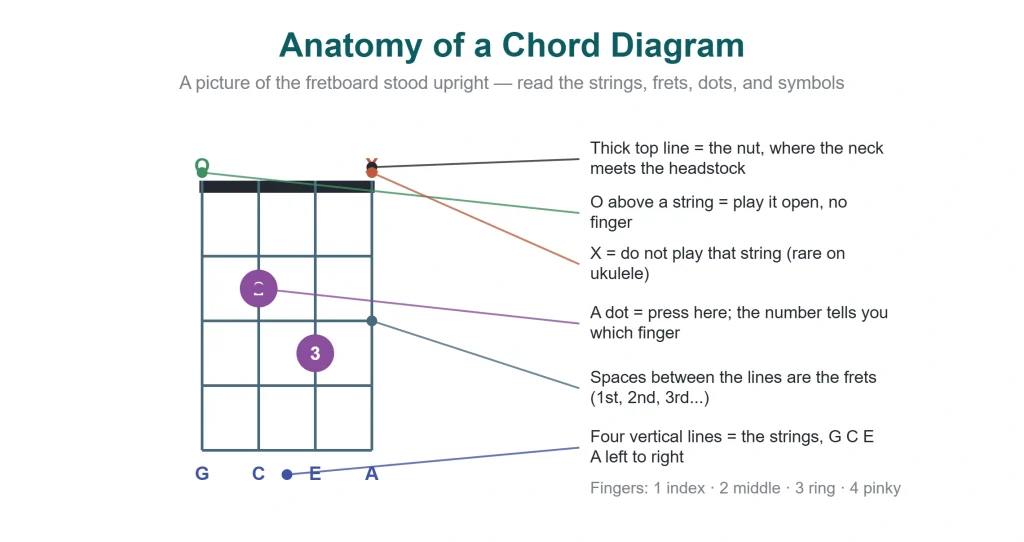
A chord diagram (also called a chord chart or chord box) is a small grid that represents the top of your ukulele’s neck as if you stood it upright and looked straight at the fretboard.
The Lines: Strings and Frets
The four vertical lines are the four strings. Reading from left to right, they are the G, C, E, and A strings, matching the order of the strings from the top of your instrument to the bottom. The horizontal lines are the frets.
The thick line across the very top represents the nut, where the fretboard meets the headstock. The space just below the nut is the 1st fret, the next space down is the 2nd fret, and so on.
The Dots and Finger Numbers
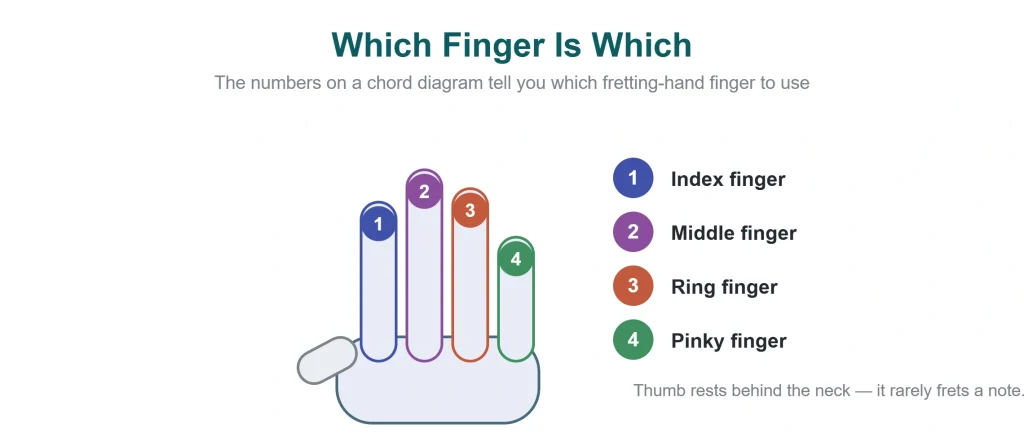
A dot placed on the grid tells you to press that string down at that fret. Often a small number sits inside or beside the dot to tell you which finger to use. The fretting-hand fingers are numbered 1 for the index, 2 for the middle, 3 for the ring, and 4 for the pinky. So a dot on the A string at the 3rd fret marked with a 3 means “press the A string at the 3rd fret with your ring finger.”
Open and Muted Strings
Symbols above the diagram, just over the nut, tell you what to do with strings you are not pressing. An O means play that string open, letting it ring without pressing anything.
An X means do not play that string at all, or mute it. On the ukulele the X is rare because most beginner chords use all four strings, but it is common on other instruments and still worth recognizing.
Chords Higher Up the Neck
Most beginner chord diagrams start at the nut. But you play some chords further up the neck. In that case, the diagram leaves off the nut and adds a small fret number to the side, such as “5fr,” telling you the top row of the grid is the 5th fret rather than the nut. Just shift your hand up to that fret and read the dots the same way.
Barre Chords
Sometimes one finger presses down several strings at once across a single fret. This is called a barre, and it is drawn as a curved line or a solid bar stretching across the strings.
You lay one finger flat to hold all those strings down together. Barre chords take practice and come a little later for most players, but recognizing the symbol now will save confusion.
Part 2: How to Read Ukulele Tabs
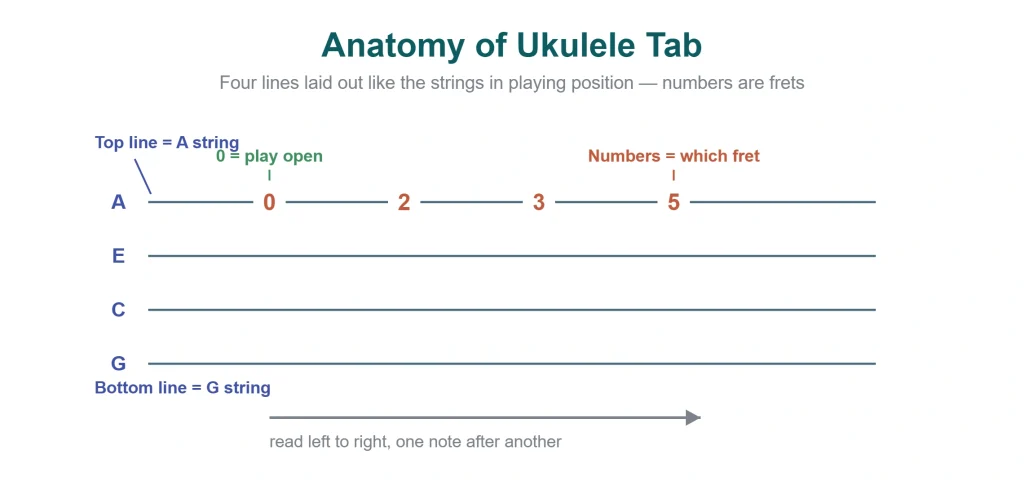
Tablature, shortened to “tab” in most song sheets, is a way of writing out which notes to play, one at a time or together. It works for melodies, riffs, and fingerpicking patterns where chord diagrams alone would not tell you enough.
The Four Lines
Ukulele tab uses four horizontal lines, one for each string. Unlike a chord diagram, here the lines are laid out horizontally like the strings when you hold the instrument in playing position. The top line is the A string (the 1st string), and the bottom line is the top G string (the 4th string), with E and C in between. Song sheets often label the lines on the left so you know which is which.
A|---------------
E|---------------
C|---------------
G|---------------
The Numbers Are Frets
A number placed on one of the lines tells you which fret to press on that string, then pluck it. A 0 means play that string open. You read tab from left to right, like reading a sentence, so notes on the left are played first and notes on the right come later.
In this example, you play the A string open, then the 2nd fret, then the 3rd fret, then the 5th fret, one note after another, climbing up in pitch:
A|--0--2--3--5--
E|--------------
C|--------------
G|--------------
Stacked Numbers Mean a Chord
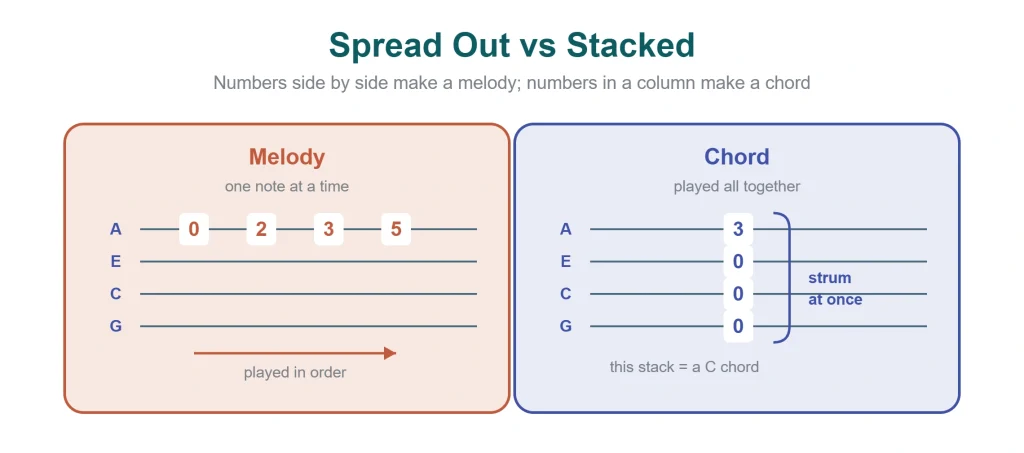
When numbers line up on top of each other in a vertical column, you play those strings at the same time, which produces a chord. The tab below tells you to strum all four strings with the A string at the 3rd fret and the rest open, which is a C chord:
A|--3--
E|--0--
C|--0--
G|--0--
So spread-out numbers mean a melody played one note at a time, and stacked numbers mean notes played together.
Common Tab Symbols
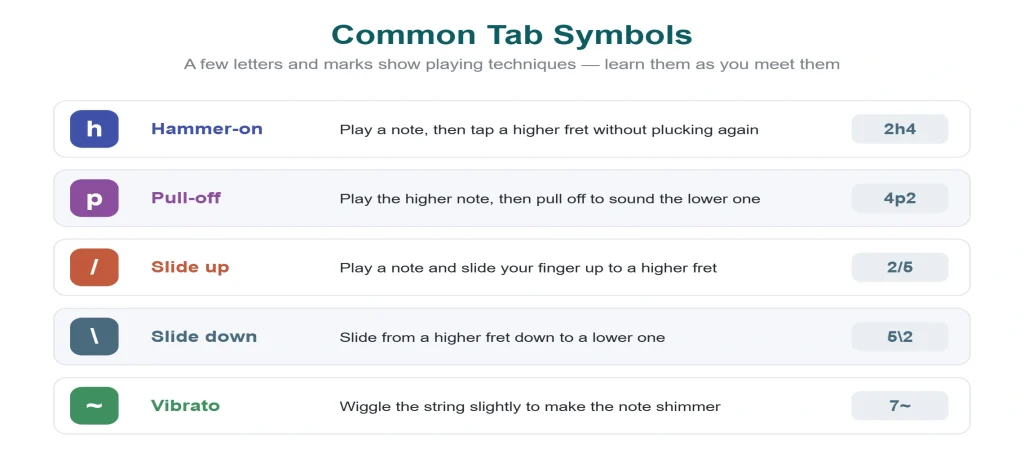
Beyond plain numbers, tab uses a few letters and marks to show playing techniques. You do not need to master these right away, but they are worth recognizing when you see them:
- h — hammer-on. Play the first note, then tap the higher fret with another finger without plucking again (for example, 2h4).
- p — pull-off. The opposite of a hammer-on: play the higher note, then pull your finger off to sound the lower one (for example, 4p2).
- / — slide up. Play a note and slide your finger up to a higher fret (for example, 2/5).
- \ — slide down. Slide from a higher fret down to a lower one.
- ~ — vibrato. Wiggle the string a little to make the note shimmer.
What Tab Does Not Tell You
Basic tab shows you which notes to play and in what order, but it does not show rhythm, meaning how long each note lasts. Because of this, tab works best for songs you already know how to sing or hum, so you can supply the timing from memory.
Some detailed tabs add rhythm notation above the lines, but for most beginner song sheets, knowing the tune is what makes the tab make sense.
Part 3: Chord Charts Over Lyrics
The third format you will meet is the simplest of all: a lyric sheet with chord names written above the words. The chord name sits right above the syllable where you should change to that chord. You strum the named chord until the next chord name appears.
This format assumes you already know how to shape each chord, which is why beginners keep a set of chord diagrams handy alongside it. If you need the shapes, our guide to easy ukulele chords for beginners gives you the finger positions for the ten most useful ones.
When to Use Each One
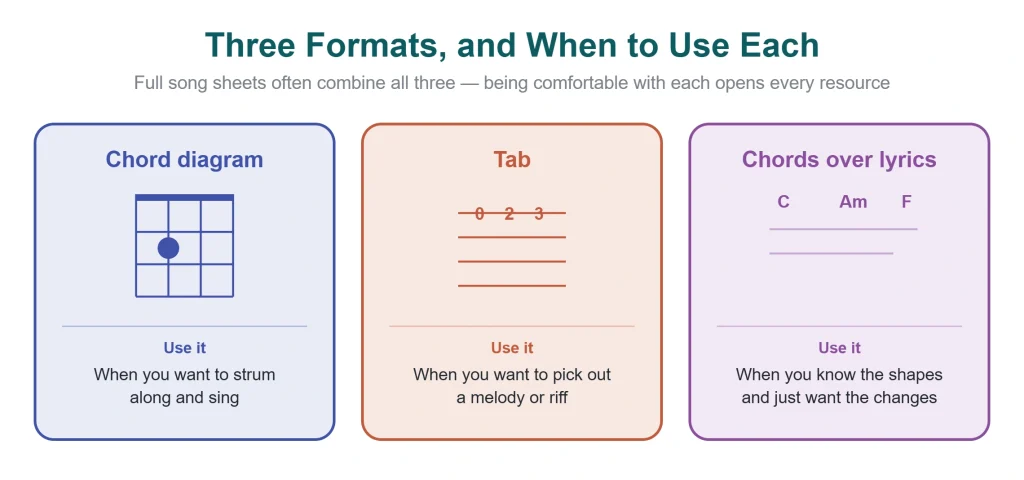
Reach for chord diagrams and lyric charts when you want to strum along and sing. Reach for tab when you want to play a melody, a solo, a riff, or a fingerpicked arrangement note by note.
Many complete song sheets combine all three: chord diagrams at the top, chord names over the lyrics, and a tab section for the intro or instrumental part. Being comfortable with each means you can learn from almost any resource you find.
Tips for Beginners
- Start with songs you already know by ear, so the missing rhythm in tab fills itself in.
- Double-check that a tab or chart is written for ukulele, not guitar, since the two use different tunings and the shapes will not match.
- Go slow at first and speed up only once the notes are clean.
- Keep a small chord-diagram reference nearby until you have the common shapes memorized.
Start Reading and Playing
Chord diagrams and tabs look like a secret code at first, but both are simple visual maps of your fretboard. Chord diagrams show you shapes to strum, tabs show you notes to pick, and chord-over-lyric sheets tie it together for singing along. Practice reading a few and they will soon feel natural.
Ready to put this into practice? Our complete beginner’s guide to playing the ukulele walks you through holding, tuning, and strumming your first song from start to finish.
Frequently Asked Questions
What is the difference between ukulele tabs and chord diagrams?
A chord diagram shows how to hold one complete chord by marking where to place your fingers on a grid of the fretboard. Tab shows individual notes to play in sequence, using four lines for the strings and numbers for the frets. Chord diagrams are for strumming, while tabs are best for melodies and fingerpicking.
Which string is the top line in ukulele tab?
In standard ukulele tab, the top line represents the A string (the 1st string, closest to the floor when you play), and the bottom line is the top G string (the 4th string). The E and C strings are the two lines in between.
Do I need to read sheet music to play the ukulele?
No. Most ukulele players never read traditional sheet music. Chord diagrams, tabs, and chord-over-lyric sheets are all much simpler systems that let you play songs without knowing standard notation.
Can I use guitar tabs for ukulele?
Not really. Guitars have six strings and a different tuning, so guitar tabs and chord shapes will not transfer to a ukulele. Look for tabs and chord charts written for ukulele.
Why doesn’t tab show the rhythm?
Basic tab focuses on which notes to play and their order, not how long each lasts. This is why it works best for songs you already know, since you supply the timing yourself. More detailed tabs sometimes add rhythm marks above the lines to fill that gap.