
If you’re deciding between the ukulele and the guitar as your first instrument, you have heard the ukulele is the easier of the two. That holds up, but the full picture is more interesting than a simple yes.
Both instruments share the same musical foundations, and the “easier” one depends on your hands, your goals, and the music you want to play. The comparison below goes point by point so you can choose with confidence.

The Short Answer
For most beginners, the ukulele is easier to pick up and play in the early stages. It has fewer strings, softer strings that are kinder to your fingertips, a smaller body, and several chords that are simple to form.
That means you can strum a recognizable song sooner on a ukulele than on a guitar. The guitar demands more at the start, but it offers a wider range and is the natural choice for certain styles of music. Neither is better; they suit different starting points.
Strings: Four Versus Six
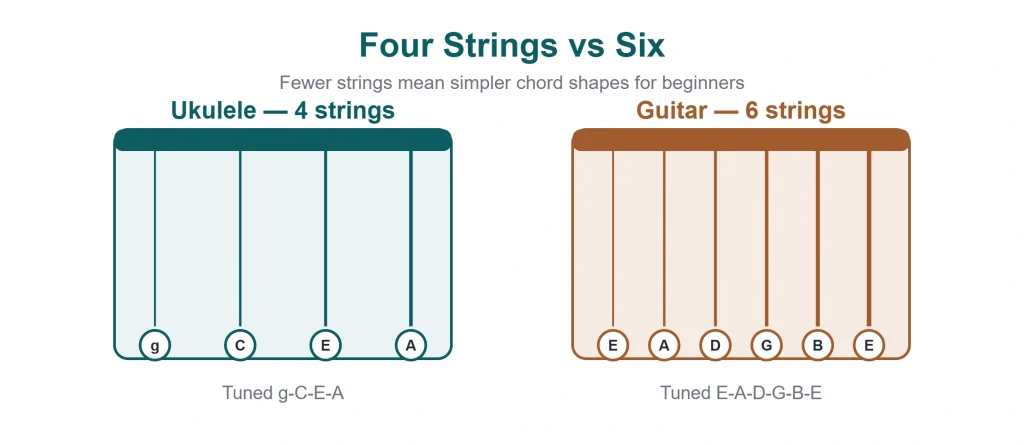
The most obvious difference is the number of strings. A standard ukulele has four strings, tuned g-C-E-A, while a standard guitar has six, tuned E-A-D-G-B-E.
Fewer strings means fewer notes to coordinate and simpler chord shapes to memorize, which is a real advantage when you’re just starting out. On the guitar, your fingers have more strings to manage and more ways to mute or buzz a note, which adds to the early learning curve.
Finger Comfort: Nylon Versus Steel
This difference matters more than beginners expect. Ukuleles use nylon or fluorocarbon strings, which are soft and gentle on the fingertips. Acoustic guitars use steel strings, which sit under higher tension and can feel uncomfortable at first, leaving fingertips sore until calluses develop.
Many new guitarists get discouraged in the first few weeks because their fingers hurt. The ukulele sidesteps this problem, letting you practice longer and in more comfort early on.
Size, Reach, and Comfort
The ukulele’s small size is a friend to beginners. Its short scale length means the frets sit close together, so your fingers don’t have to stretch far to form chords. The guitar’s longer neck and wider fret spacing demand more reach and more hand strength, which can be challenging for people with smaller hands or for younger players.
The ukulele’s light, compact body is also easier to hold and more portable, making it simple to pick up for a few minutes of casual practice.
Chords: Where the Ukulele Really Shines
The gap shows most in the chords. On the ukulele, the C chord takes a single finger, and many other common chords use just one, two, or three fingers in comfortable shapes. A total beginner can strum a full song within their first day or two.
On the guitar, many first chords are harder, and the notorious F chord and B chord require a barre, where one finger presses down several strings at once. Barre chords are a common stumbling block that can take weeks or months to master, and they stop many guitar beginners in their tracks.
If you want to start strumming songs soon, the ukulele’s friendly chords are one of its biggest advantages. You can explore them in our guide to easy ukulele chords for beginners.
Side-by-Side Comparison
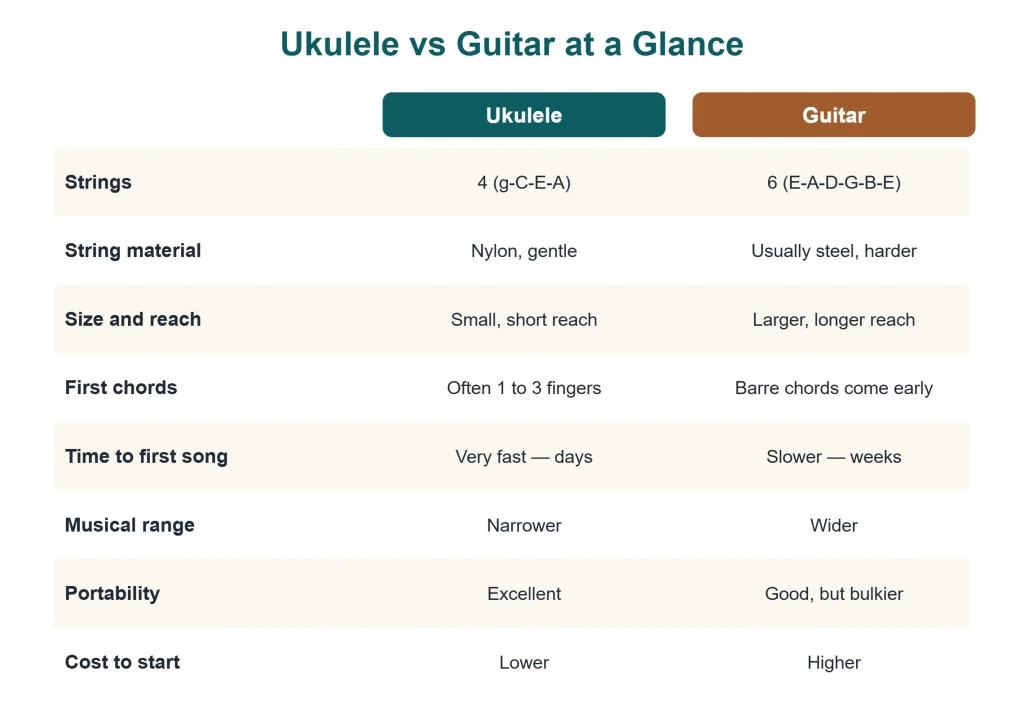
| Factor | Ukulele | Guitar |
|---|---|---|
| Number of strings | 4 (g-C-E-A) | 6 (E-A-D-G-B-E) |
| String material | Nylon or fluorocarbon, gentle | Usually steel, harder on fingers |
| Size and reach | Small, short reach | Larger, longer reach |
| First chords | Often one to three fingers | Often harder, barre chords come early |
| Time to first song | Very fast, days | Slower, weeks |
| Musical range | Narrower | Wider |
| Portability | Excellent | Good, but bulkier |
| Typical cost to start | Lower | Higher |
Where the Guitar Has the Edge
The guitar’s greater difficulty comes with real rewards. With six strings and a longer neck, it offers a wider range of notes, richer bass, and more harmonic possibilities. It’s the backbone of countless genres, from rock and blues to folk and classical, and if your heart is set on playing that kind of music, the guitar is the natural home for it.
The extra effort at the start pays off in versatility. The ukulele is expressive, but it doesn’t cover the same sonic ground as a full guitar.
Do the Skills Transfer?
Learning one instrument helps with the other. Strumming patterns, rhythm, chord theory, and general musicianship all carry over. The top four strings of a guitar are tuned in the same intervals as a ukulele (just at a different pitch), so ukulele chord shapes have direct cousins on the guitar.
Many people start on the ukulele to build confidence and comfortable habits, then move to the guitar later and find the transition far smoother than starting on guitar cold. Starting with the ukulele is never wasted effort.
Which Should You Choose?
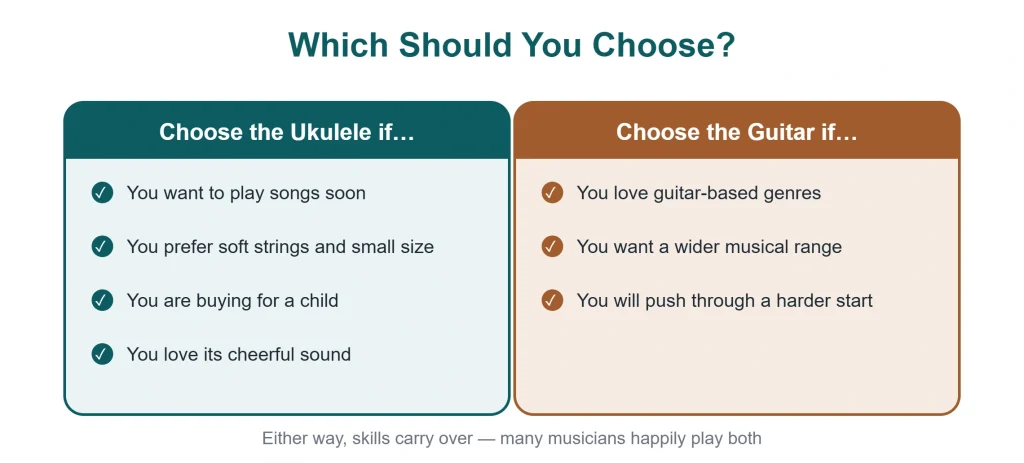
Choose the ukulele if you want to start playing songs soon, prefer soft strings and a small instrument, are buying for a child, or love its cheerful sound. Choose the guitar if you’re drawn to genres built around it and are willing to push through a tougher first few weeks for a wider musical range down the road.
It isn’t a lifelong commitment either way. Plenty of musicians play both. If you’re leaning toward the ukulele, our complete beginner’s guide to playing the ukulele and our first ukulele buyer’s guide will help you get going.
The Bottom Line
The ukulele is the easier instrument to start with for most people, thanks to its four soft strings, small size, and simple chords, and it gets you making music fast.The guitar asks more of you at the beginning but rewards you with greater range and versatility.
Both are wonderful, and skills learned on one help with the other, so you can’t make a wrong choice. If quick wins and comfort appeal to you, the ukulele is a joyful place to begin your musical journey.
Frequently Asked Questions
Is the ukulele easier than the guitar?
For most beginners, yes. The ukulele has fewer strings, softer strings that are kinder to your fingertips, a smaller body, and simpler beginner chords, so you can play a song sooner than on a guitar.
Should I learn ukulele before guitar?
It’s a great path. The ukulele builds rhythm, chord, and strumming skills with ease, and because its shapes relate to the top four strings of a guitar, many players find switching to guitar later feels much smoother.
Why do guitar strings hurt more than ukulele strings?
Acoustic guitars have steel strings under higher tension, which can make fingertips sore until calluses form. Ukuleles use soft nylon or fluorocarbon strings, so they are far gentler and more comfortable for beginners.
Can I play guitar songs on a ukulele?
You can adapt many songs to the ukulele using ukulele chord shapes, and countless popular tunes have ukulele arrangements. The sound and range differ from a guitar version, but the chords and melody translate well.
Is the guitar worth the extra difficulty?
If you love genres built around the guitar and want its wider range and richer sound, the extra effort at the start is well worth it. If you want quick, joyful strumming, the ukulele may suit you better.