
Whether you are playing your very first song or filling gaps in your chord vocabulary, this ukulele chords chart puts every shape you need in one place.
Use the interactive chord finder below to pick any chord, see exactly where your fingers go on the fretboard, and hear how it should sound. Then scroll down for a full printable chord chart, the four easy chords every beginner should learn first, and a plain-English guide to reading chord diagrams.
Every chord on this page is written for standard G-C-E-A tuning, which is by far the most common ukulele tuning. If your ukulele is not in tune yet, run it through our free online ukulele tuner first, because even a perfect chord shape sounds wrong on an out-of-tune instrument.
Sharps are shown (A# = B♭, D# = E♭, and so on). All diagrams are for standard G-C-E-A tuning. Numbers show the fret; ● means press, ○ means play the string open.
How to use the ukulele chord finder
The finder is built to answer one question fast: “Where do I put my fingers for this chord?” Here is the quickest way to use it.
- Pick a root note (C, D, E, F, G, A, or B, plus sharps and flats).
- Pick a chord type — major, minor, or 7th are the three you will use most.
- Click the chord to load its diagram. The dots show which fret to press and which finger to use.
- Tap the play button to hear the chord so you can check your fingers are giving you the right sound.
- Strum slowly, one string at a time, to make sure every note rings cleanly before you speed up.
How to read a ukulele chord diagram
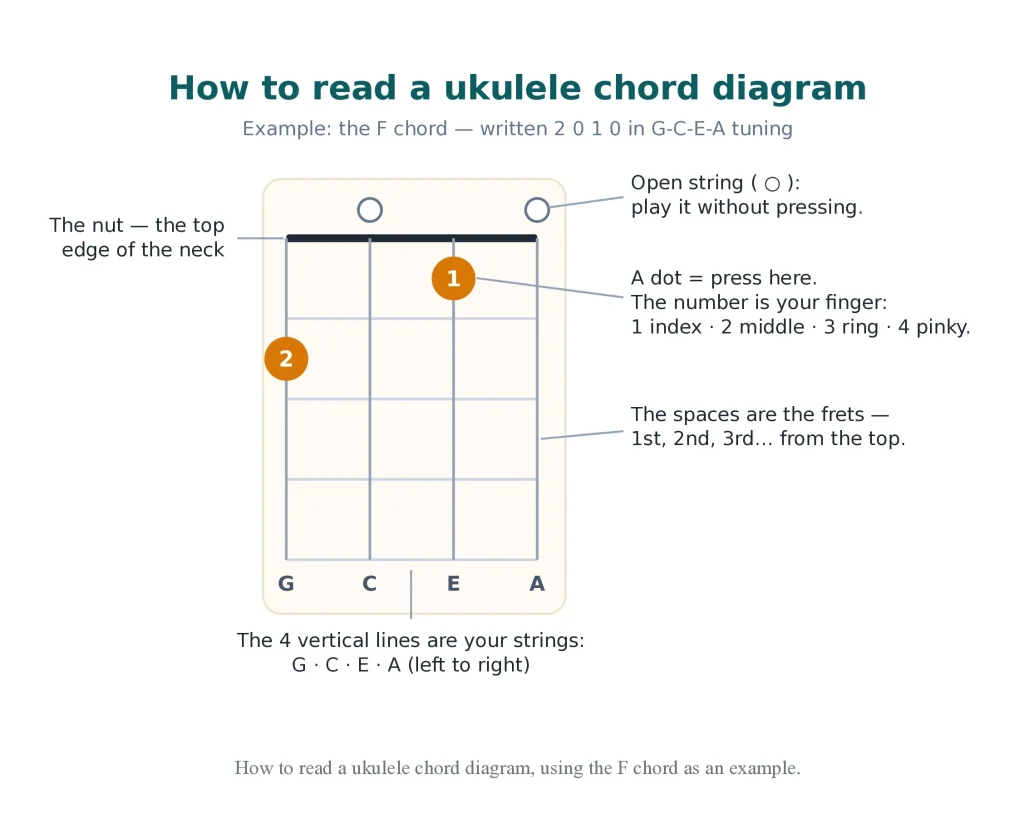
A ukulele chord diagram (also called a chord box) is a simple picture of the top of your fretboard. Once you can read one, you can learn any chord in seconds. Here is what every part means.
- The four vertical lines are your strings. Reading left to right, they are G, C, E, and A — the same order as your ukulele when you look down at it while playing.
- The horizontal lines are your frets. The thick line at the very top is the nut (the top of the neck). The spaces between the lines are the first fret, second fret, and so on going down.
- The dots show where to press. A dot placed in the second fret of a string means you hold that string down at the second fret.
- The numbers on the dots are your fingers: 1 = index, 2 = middle, 3 = ring, 4 = pinky.
- A “0” above a string means play it open (do not press it at all). An “X” means do not play that string — though on ukulele almost every chord uses all four strings, so you will rarely see an X.
If you also want to understand tab notation and rhythm slashes, our guide on how to read ukulele tabs and chord diagrams walks through both in detail.
The 4 chords every beginner needs: C, Am, F, and G
You do not need to learn all of these chords at once. If you learn just these four, you can play hundreds of popular songs. They are the best possible starting point because they are easy to hold and they work together in the same key.
| Chord | Frets (G · C · E · A) | Fingers | Why it is great |
|---|---|---|---|
| C major | 0 0 0 3 | Ring finger on the A string, 3rd fret | One finger, and it sounds fantastic — the perfect first chord. |
| A minor (Am) | 2 0 0 0 | Middle finger on the G string, 2nd fret | The easiest minor chord on the instrument. |
| F major | 2 0 1 0 | Index on E string 1st fret, middle on G string 2nd fret | Just two fingers and it opens up dozens of songs. |
| G major | 0 2 3 2 | Index on C 2nd, middle on A 2nd, ring on E 3rd | Forms a small triangle shape you will use constantly. |
Want a slower, song-by-song walkthrough of these shapes? Read 10 easy ukulele chords every beginner should learn first for practice tips and simple songs that use only these chords.
Major, minor, and 7th chords — what is the difference?
Almost every chord you meet falls into one of three families. Knowing the difference helps you understand why a song sounds happy, sad, or bluesy, and it makes the chart below far less intimidating.
Major chords
Major chords sound bright, happy, and resolved. When a chord is written with just a letter — C, F, G, D — it is major. These are the backbone of cheerful, singalong songs.
Minor chords
Minor chords sound softer, sadder, or more thoughtful. They are written with a small “m” after the letter — Am, Em, Dm. Mixing minors with majors is what gives a song emotional depth.
7th chords
7th chords add a little tension and a bluesy, “unfinished” flavour that pulls your ear toward the next chord. They are written with a 7 — G7, C7, D7. They are extremely common in folk, blues, and classic pop, and most are just as easy to play as major chords.
Full ukulele chords chart
Here is a complete reference chart of the most-used ukulele chords in standard G-C-E-A tuning. The four numbers show which fret to press on each string, in the order G · C · E · A (0 means play the string open). Bookmark or print this chart so you always have it handy.
| Chord | Frets (G · C · E · A) | Type | Difficulty |
|---|---|---|---|
| A | 2 1 0 0 | Major | Easy |
| Am | 2 0 0 0 | Minor | Easy |
| A7 | 0 1 0 0 | Dominant 7th | Easy |
| Am7 | 0 0 0 0 | Minor 7th | Easy |
| Amaj7 | 1 1 0 0 | Major 7th | Easy |
| Bb | 3 2 1 1 | Major (barre) | Hard |
| Bm | 4 2 2 2 | Minor (barre) | Hard |
| B7 | 2 3 2 2 | Dominant 7th | Medium |
| C | 0 0 0 3 | Major | Easy |
| Cm | 0 3 3 3 | Minor (barre) | Hard |
| C7 | 0 0 0 1 | Dominant 7th | Easy |
| Cmaj7 | 0 0 0 2 | Major 7th | Easy |
| D | 2 2 2 0 | Major | Medium |
| Dm | 2 2 1 0 | Minor | Easy |
| D7 | 2 2 2 3 | Dominant 7th | Medium |
| E | 4 4 4 2 | Major | Hard |
| Em | 0 4 3 2 | Minor | Medium |
| E7 | 1 2 0 2 | Dominant 7th | Medium |
| F | 2 0 1 0 | Major | Easy |
| Fm | 1 0 1 3 | Minor | Medium |
| G | 0 2 3 2 | Major | Easy |
| Gm | 0 2 3 1 | Minor | Medium |
| G7 | 0 2 1 2 | Dominant 7th | Easy |
Ukulele chords grouped by key
Songs are usually built from a small family of chords that belong to the same key. If you learn the chords in a key together, you can play almost any song written in that key — and it makes writing your own chord progressions much easier. Here are three of the most beginner-friendly keys on the ukulele.
Key of C
| Chord | Frets (G · C · E · A) | Type |
|---|---|---|
| C | 0 0 0 3 | Major (I) |
| Dm | 2 2 1 0 | Minor (ii) |
| Em | 0 4 3 2 | Minor (iii) |
| F | 2 0 1 0 | Major (IV) |
| G | 0 2 3 2 | Major (V) |
| Am | 2 0 0 0 | Minor (vi) |
| G7 | 0 2 1 2 | Dominant 7th |
Key of G
| Chord | Frets (G · C · E · A) | Type |
|---|---|---|
| G | 0 2 3 2 | Major (I) |
| Am | 2 0 0 0 | Minor (ii) |
| Bm | 4 2 2 2 | Minor (iii) |
| C | 0 0 0 3 | Major (IV) |
| D | 2 2 2 0 | Major (V) |
| Em | 0 4 3 2 | Minor (vi) |
| D7 | 2 2 2 3 | Dominant 7th |
Key of F
| Chord | Frets (G · C · E · A) | Type |
|---|---|---|
| F | 2 0 1 0 | Major (I) |
| Gm | 0 2 3 1 | Minor (ii) |
| Am | 2 0 0 0 | Minor (iii) |
| Bb | 3 2 1 1 | Major (IV, barre) |
| C | 0 0 0 3 | Major (V) |
| Dm | 2 2 1 0 | Minor (vi) |
| C7 | 0 0 0 1 | Dominant 7th |
A quick tip for barre chords
A barre chord is any chord where one finger presses down several strings at once, like a moveable “bar” across the fretboard. On ukulele the most common ones are Bb (3 2 1 1), Bm (4 2 2 2), and the full E shape (4 4 4 2). They feel hard at first, so do not worry if they buzz — every player goes through this. These tips make them click faster.
- Use the side of your index finger (the bony edge), not the soft flat pad — it presses the strings down more evenly.
- Keep the barring finger close to the fret, not in the middle of the space, so you need less pressure.
- Press your thumb into the back of the neck directly behind the barre for extra squeeze.
- Build strength gradually. A few minutes a day beats one long, frustrating session.
Ukulele chords FAQ
What are the easiest ukulele chords for beginners?
The four easiest and most useful chords to start with are C (0 0 0 3), A minor (2 0 0 0), F (2 0 1 0), and G (0 2 3 2). C needs only one finger, and together these four let you play hundreds of songs.
How many chords should a beginner learn first?
Start with just four: C, Am, F, and G. Once those feel comfortable and you can switch between them smoothly, add G7, D, and Em. That handful covers the vast majority of beginner songs.
Are ukulele chords the same as guitar chords?
No. A ukulele is tuned G-C-E-A while a guitar is tuned E-A-D-G-B-E, so the same chord shape produces a different chord. A “C shape” on ukulele is not the same as a C on guitar. The good news is that ukulele shapes are usually simpler, since you only fret four strings instead of six.
What do the numbers on a ukulele chord chart mean?
The numbers show which fret to press on each string, listed in the order G · C · E · A. For example, C is written 0 0 0 3, which means leave the G, C, and E strings open and press the A string at the third fret. On a diagram, the small number on each dot tells you which finger to use.
Can I use this chord chart for a baritone ukulele?
No. This chart is for standard G-C-E-A tuning. A baritone ukulele is tuned D-G-B-E (like the top four guitar strings), so its chord shapes are different. Every chord on this page assumes standard soprano, concert, or tenor tuning.
Related ukulele guides
- Free online ukulele tuner — get in tune before you play a single chord.
- How to tune a ukulele: the standard G-C-E-A tuning explained.
- 10 easy ukulele chords every beginner should learn first.
- How to read ukulele tabs and chord diagrams.
- Ukulele strumming patterns for beginners — put your new chords to a rhythm.