
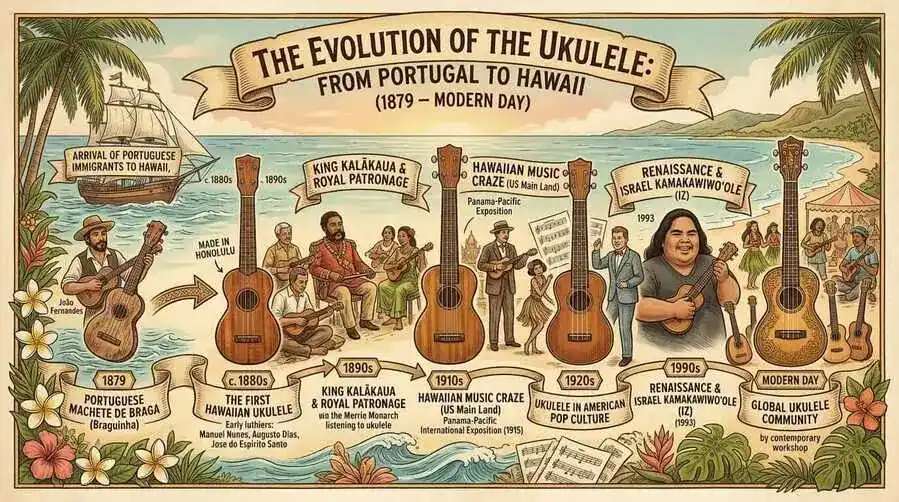
The ukulele history timeline starts in 1879, when Portuguese immigrants introduced small string instruments to Hawaii. It evolved into the ukulele, gained worldwide attention in 1915, and became a national craze in the 1920s. Today, it remains a global instrument loved by beginners and musicians alike.
This ukulele history timeline traces that journey in order. If you want a quick history of the ukulele, you’ll find the key moments here without getting lost in details. From its Hawaiian beginnings to its global rise, the story runs step by step, easy to follow.
A Quick Look at the Ukulele History Timeline
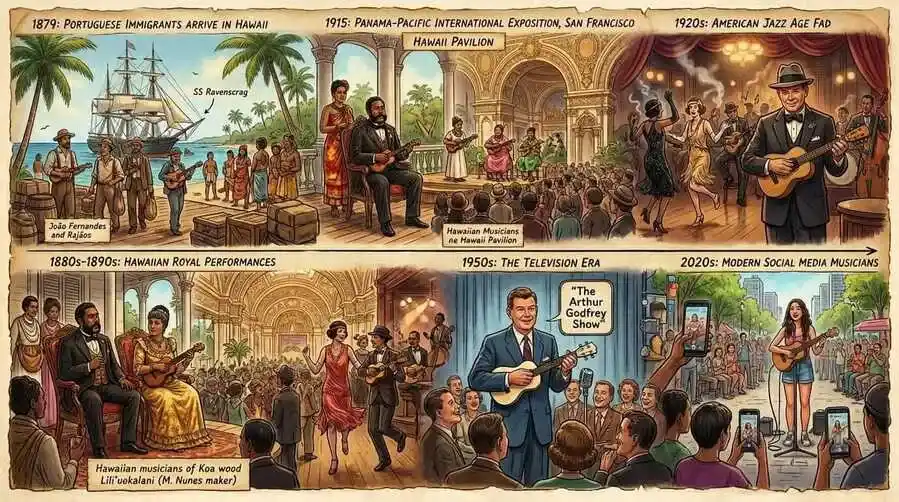
If you just want a brief history of the ukulele, this quick timeline covers the key moments without extra detail. It’s a simple way to see how the instrument moved from Hawaii to the rest of the world.
- 1879 — Portuguese immigrants arrive in Hawaii aboard the ship Ravenscrag with small string instruments that later inspire the ukulele
- 1880s–1890s — The instrument is adopted and supported by Hawaiian royalty, including King Kalākaua, helping it grow in status
- 1915 — The Panama-Pacific International Exposition in San Francisco introduces the ukulele to a global audience
- 1920s — A major popularity boom in the United States during the Jazz Age
- 1930s–1960s — Interest fades, then returns through radio, film, and television
- 1990s–2000s — A quiet revival begins, driven by Hawaiian musicians and global curiosity
- Today — The ukulele thrives worldwide as an accessible and widely played instrument
This quick ukulele history timeline gives you the full picture at a glance, before we look at each stage in more detail.
1879–1890s — The Birth of the Ukulele in Hawaii
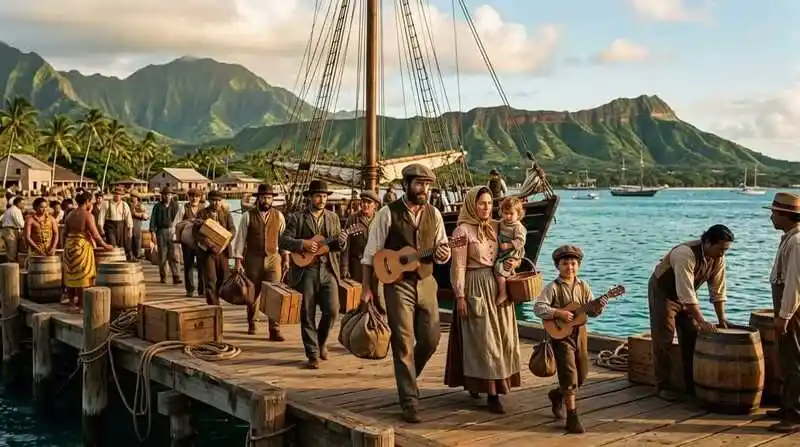
The story begins in 1879, when Portuguese immigrants from the island of Madeira arrived in Hawaii aboard the ship Ravenscrag, carrying small string instruments like the machete (also called the braguinha) and the rajão. These were simple, portable, and already popular in Madeira. But once they reached the islands, something started to change.
Local craftsmen and musicians adapted the design, shaping it into a new instrument with a distinct sound and identity. Three cabinetmakers who had made the voyage got credit as the first ukulele builders in Hawaii: Manuel Nunes, José do Espírito Santo, and Augusto Dias. The new instrument was smaller and lighter, and it settled into a bright, re-entrant G-C-E-A tuning, with the top G string pitched high. Over time, it became tied to Hawaiian music. It felt native to the islands rather than borrowed.
Hawaiians embraced it fast. Within a couple of decades, few thought of the ukulele as a foreign instrument. It had become part of everyday life, played at gatherings, celebrations, and in royal circles, often built from the native Hawaiian koa wood that gave it a warm tone.
The Jumping Flea Name Origin
The name “ukulele” is often translated as “jumping flea.” The common account traces it to the fast movement of a player’s fingers across the strings, quick and lively, like something hopping back and forth. One popular version links the nickname to Edward Purvis, a British army officer at the Hawaiian court known for his small size and quick movements. A competing story says Queen Liliʻuokalani preferred the meaning “the gift that came here,” from the Hawaiian words uku and lele. The origin is disputed, but either way the name captures the playful character the instrument still carries today.
Early 1900s — From Island Instrument to Global Curiosity
By the early 1900s, the ukulele was no longer just a local Hawaiian instrument. Its presence had grown stronger with the support of the Hawaiian royal court. King Kalākaua, who reigned until 1891 and was a devoted patron of Hawaiian music and dance, played a key role in promoting the culture, often including the ukulele in royal performances and gatherings. His sister, Queen Liliʻuokalani, herself a composer, helped carry that support forward.
At the same time, craftsmanship improved. Skilled makers in Hawaii, including Manuel Nunes and his workshop, refined the design, experimenting with wood, size, and tone. The instrument became more consistent in quality, which helped it gain wider appeal beyond the islands.
Then it began to travel. Visitors, musicians, and performers carried the ukulele with them, introducing it to audiences outside Hawaii. It wasn’t mainstream yet, but curiosity had started to build. The next big shift was around the corner.
1915 — The Moment That Changed Everything
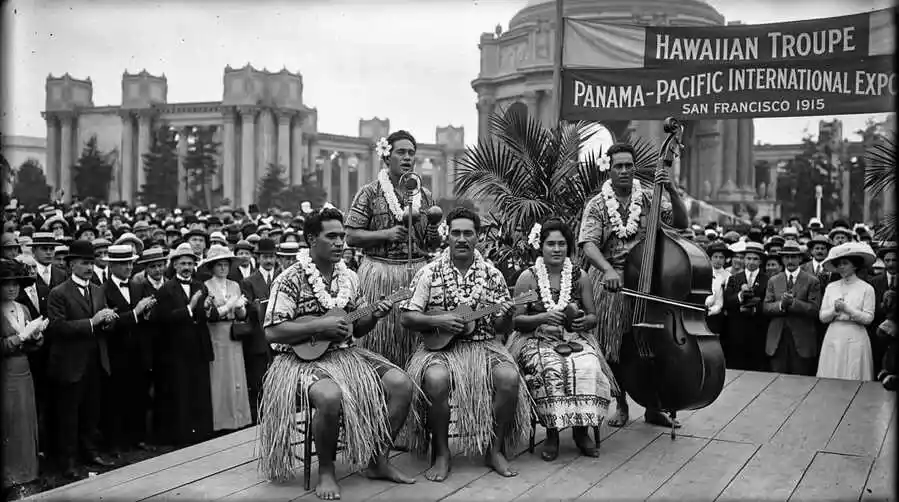
In 1915, the ukulele stepped onto a much bigger stage at the Panama-Pacific International Exposition in San Francisco. Hawaiian musicians performed at the Hawaiian Pavilion for large crowds, and by many accounts George E. K. Awai and his Royal Hawaiian Quartet were among them. For many visitors, this was their first time hearing the instrument live.
The reaction was immediate. The sound felt light, cheerful, and easy to connect with. People didn’t just listen, they wanted to play it. Soon after, the ukulele began appearing in music stores across the mainland United States, marking the start of its commercial rise.
An instrument once tied to Hawaii was now moving outward, finding a new audience far beyond the islands.
Why This Event Matters More Than People Think
It wasn’t just about exposure. The 1915 event changed how people saw the ukulele. Instead of a regional or cultural instrument, it became something accessible to everyday players. That shift opened the door for mass production, music publishing, and the popularity wave that followed in the 1920s.
1920s Ukulele Boom — America Falls in Love
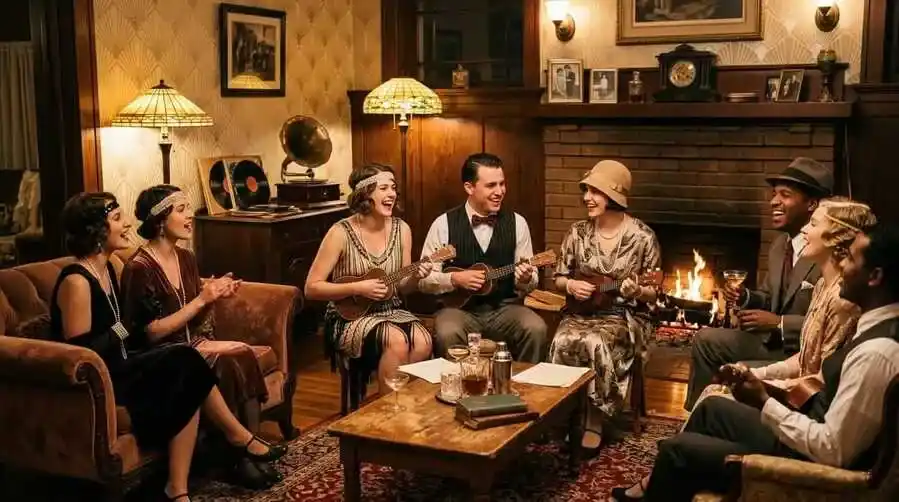
The 1920s changed everything. Curiosity turned into a full-blown craze. This period in 1920s ukulele history saw the instrument move from novelty to mainstream across the United States.
Manufacturers stepped in to meet demand. Established guitar makers like C. F. Martin, which had begun building ukuleles around 1916, produced them at scale, which made them widely available. At the same time, the Jazz Age created the perfect setting. Music was lively, social, and always changing, and the ukulele fit right in.
It also started showing up everywhere. In songbooks, stage performances, and popular entertainment. The instrument was no longer tied to one place. It had become part of everyday culture.
The Role of Music Publishing and Radio
Sheet music played a huge role in spreading the ukulele. Tin Pan Alley publishers printed popular songs with simple ukulele chord diagrams right above the staff, so beginners could start playing right away. You didn’t need formal training. Just a basic guide and a bit of rhythm.
Radio added another layer. As broadcasts reached more homes through the 1920s, people heard the ukulele week after week. That familiarity helped it grow faster than most instruments of the time.
Affordable Instruments and Everyday Players
One reason for its success was simple. It was affordable. Compared to larger instruments, the ukulele cost less and felt less intimidating to learn.
Families bought them. Students picked them up. Even people with no musical background gave it a try. That wide accessibility turned the ukulele into something personal. You didn’t just listen to it. You played it yourself.
1930s–1960s — Decline, Then an Unexpected Revival
After the excitement of the 1920s, things slowed down. The Great Depression changed how people spent money, and musical trends began to shift. Bigger band sounds and new styles started to take over, pushing the ukulele out of the spotlight.
For a while, it faded into the background. It was still around, but no longer at the center of popular music. By the 1940s, it had become more of a niche instrument again.
Then it returned. In the 1950s and early 1960s, the ukulele found its way back into homes and living rooms. This time, the path was different. Everyday media and familiar faces carried it, not large events or sudden trends.
Television and the Return of the Ukulele
Television played a big role in this comeback. In the early 1950s, performers like Arthur Godfrey brought the ukulele into millions of homes through regular broadcasts, even promoting inexpensive plastic models that put the instrument within nearly everyone’s reach. His relaxed style made the instrument feel approachable again.
A little later, artists such as Tiny Tim added their own personality to it, best known through his 1968 hit “Tiptoe Through the Tulips.” The sound was different from before, but the charm was still there. The ukulele found its place once more, even if it looked a little different than it had in the past.
1990s–2000s — The Quiet Comeback
The ukulele didn’t return with a loud moment this time. Its comeback in the 1990s and early 2000s was quieter, almost gradual. It started in Hawaii, where musicians began reconnecting with traditional sounds and bringing the instrument back into focus.
Artists like Israel Kamakawiwoʻole played a big role in this shift. His 1993 medley of “Somewhere Over the Rainbow” and “What a Wonderful World” reached listeners far beyond the islands, showing that the ukulele could carry emotion, depth, and simplicity all at once.
At the same time, indie and folk musicians around the world began picking it up. It fit their style. Small, expressive, and easy to travel with. Then the internet changed everything. When Jake Shimabukuro’s fingerstyle cover of “While My Guitar Gently Weeps” went viral in 2006, early video platforms and online communities let anyone learn, share, and perform. The ukulele was no longer tied to one place. It spread into a global space.
Modern Day — The Ukulele’s Global Identity

Today, the ukulele feels everywhere. Not in an overwhelming way, but in a quiet, steady presence across different cultures and platforms. Open YouTube or scroll through social media, and you’ll find players of all levels sharing songs, lessons, and simple covers.
Learning has also changed. Online tutorials, short videos, and beginner courses have made it easier than ever to start. You don’t need formal training or expensive gear. Just a basic instrument and a bit of time.
It’s part of classrooms now, used in music education because it’s approachable and easy to teach. At the same time, it shows up in professional recordings, live performances, and independent music scenes around the world. The reach is wide, but it still feels personal.
Why the Ukulele Keeps Growing
Part of it comes down to how simple it feels at the start. You can learn a few chords in an afternoon and play real songs without much struggle.
But there’s more to it. The sound is warm, light, and a little different from everything else. It doesn’t try to dominate. It fits in, or stands out, depending on how it’s played. That balance is probably why people keep coming back to it.
Timeline Highlights (Key Takeaways)
If you want a quick history of the ukulele without reading every section again, these are the moments that shaped its journey:
- 1879 — Small Portuguese instruments arrive in Hawaii aboard the Ravenscrag and begin evolving into the ukulele
- Late 1800s — Hawaiian royalty, including King Kalākaua, helps bring the instrument into cultural prominence
- 1915 — The Panama-Pacific International Exposition in the United States introduces it to a global audience
- 1920s — A nationwide boom turns it into a popular household instrument
- Mid-1900s — Interest declines, then returns through media and entertainment
- 1990s onward — A steady revival reconnects it with both tradition and modern music
- Today — The ukulele is played worldwide, from beginners to professional musicians
This brief history of the ukulele shows how fast it moved from a local creation to a global instrument, with each era adding something to its identity.
If you enjoyed this timeline but want the full story behind each era, take a look at our complete guide to the history of the ukulele. It covers the instrument’s origins, Hawaiian roots, cultural evolution, and global rise in far more detail.
Frequently Asked Questions
When did the ukulele become popular in America?
The instrument gained major attention in the United States after the 1915 Panama-Pacific Exposition and became especially popular during the 1920s.
Why is the ukulele called a “jumping flea”?
The name likely comes from the quick movement of a musician’s fingers across the strings while playing.
Did the ukulele lose popularity at one point?
Yes. Interest declined during the mid-1900s as musical styles changed, though the instrument later experienced several revivals.
Why is the ukulele popular again today?
Social media, online lessons, and beginner-friendly learning have helped introduce the ukulele to a new generation of players worldwide.